
Table of Contents
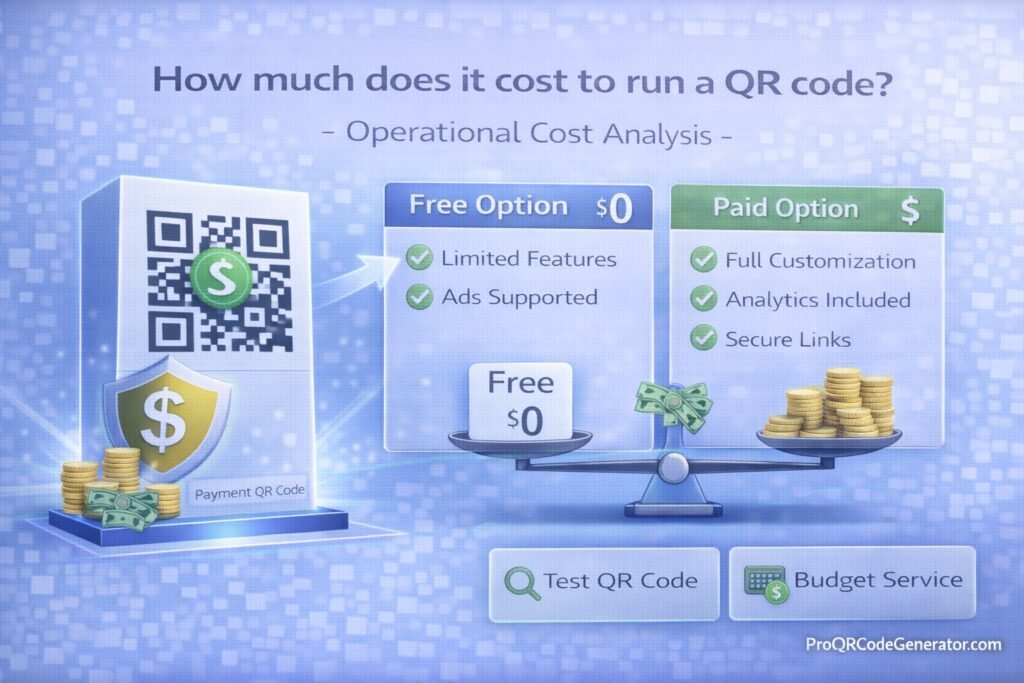
If you’re evaluating digital engagement tools, one critical question arises: how much does it cost to run a QR code? – operational cost analysis is essential before deploying QR codes at scale.
At first glance, QR codes appear free. You generate an image, download it, print it, and you’re done.
But running a QR code—especially for business, marketing, or payment purposes—involves more than generating a square graphic. The real cost includes infrastructure, hosting, analytics, security, maintenance, campaign optimization, and scalability.
This guide provides a full financial breakdown, from zero-cost static codes to enterprise-grade dynamic QR systems.
What Does Running a QR Code Actually Mean?
Before calculating cost, we must define what “running” entails.
Running a QR code includes:
- Generating the code
- Hosting the destination content
- Managing redirects
- Monitoring scans
- Maintaining uptime
- Updating links when needed
- Analyzing performance
- Securing the experience
Creation is one-time. Running is ongoing.
That distinction is the foundation of any realistic operational cost analysis.
Static QR Code Costs Explained
Creation Cost: Often Free
Static QR codes can be generated at no cost using free tools.
They:
- Embed a fixed URL
- Cannot be edited
- Do not provide analytics
- Have no recurring subscription
From a surface-level perspective, static QR codes cost $0.
But zero upfront cost does not equal zero operational cost.
Hidden Costs of Static QR Codes
1. Reprinting Costs
If your URL changes:
- All printed materials must be replaced
- Packaging must be redesigned
- Posters must be reprinted
For businesses printing 5,000–50,000 units, this becomes expensive quickly.
2. No Analytics = Optimization Blind Spot
Without tracking:
- You cannot measure scan volume
- You cannot track conversions
- You cannot attribute ROI
- You cannot detect campaign failure
The opportunity cost of not optimizing can exceed subscription fees.
3. Expired or Broken Links
If your hosting changes or domain expires, the static QR code becomes useless.
The cost here is brand damage and lost engagement—not just reprinting.
Dynamic QR Code Costs Explained
Dynamic QR codes introduce infrastructure—but also control.
Instead of embedding the final URL, they use a redirect layer that can be updated after printing.
This adds subscription cost but reduces long-term risk.
Subscription Pricing Models
Dynamic QR platforms typically charge:
- Monthly subscription
- Annual subscription (discounted)
- Tiered pricing based on:
- Number of QR codes
- Scan limits
- Analytics features
- Team members
- API access
Typical ranges in the market:
- Entry-level: $5–$15/month
- Professional: $15–$49/month
- Enterprise: Custom pricing
What’s Included in Paid QR Systems?
Professional QR platforms include:
- Editable redirects
- Advanced analytics
- Unlimited scans
- Branded customization
- Dashboard management
- Scan tracking by device/location
- Campaign management
- SSL-secured redirect infrastructure
Platforms such as ProQRCodeGenerator.com offer dynamic QR codes with unlimited scans, editable links after printing, custom branding, and advanced analytics—features that directly impact operational efficiency.
Full QR Code Operational Cost Breakdown
Let’s break down real expenses.
1. Software / SaaS Fees
Dynamic QR platform subscription:
- $0 (static)
- $10–$50/month (professional use)
- Enterprise: negotiated pricing
Annualized:
- $120–$600/year typical business range
2. Printing & Material Costs
Printing costs vary:
- Flyers: low
- Product packaging: moderate
- Outdoor signage: high
- Retail displays: higher durability materials required
If reprinting occurs due to static QR inflexibility, costs multiply.
Dynamic QR codes reduce reprint risk by allowing URL edits without replacing physical assets.
3. Hosting & Domain Costs
If QR codes link to:
- Custom landing pages
- Campaign microsites
- Payment gateways
You must budget:
- Domain: $10–$20/year
- Hosting: $5–$30/month
- SSL certificate (often included)
4. Payment Processing Fees (If Applicable)
For payment QR codes:
- 2–3% per transaction (card processors)
- Crypto network fees
- Gateway transaction fees
These are transaction costs—not QR costs—but part of operational analysis.
5. Staff & Management Overhead
Running QR campaigns involves:
- Marketing setup
- Landing page optimization
- Analytics review
- Campaign reporting
The larger your deployment, the more management time required.
Dynamic dashboards simplify oversight, reducing administrative hours.
Cost Per Scan Analysis
One of the most practical ways to assess QR cost is cost-per-scan.
Example:
- QR subscription: $30/month
- 3,000 scans/month
- Cost per scan = $0.01
If even 2% convert and average order value is $50:
- 60 conversions
- $3,000 revenue
- ROI dramatically outweighs infrastructure cost
In this model, the QR system is not a cost center—it’s a revenue multiplier.
Static vs Dynamic Lifetime Cost Comparison
| Factor | Static QR | Dynamic QR |
|---|---|---|
| Upfront Cost | $0 | Subscription |
| Edit After Print | No | Yes |
| Analytics | None | Advanced |
| Reprint Risk | High | Low |
| Scalability | Limited | High |
| Lifetime Cost | Unpredictable | Controlled |
Static QR codes look free. Dynamic QR codes look paid.
But long-term operational cost often favors dynamic systems.
Industry Cost Examples
1. Restaurant Scenario
Static QR menu:
- Free generation
- URL changes → reprint menus
Dynamic QR menu:
- $15/month
- Editable after printing
- Track table scans
- Monitor peak hours
Operationally, dynamic reduces friction and supports analytics.
2. Retail Packaging
5,000 product boxes printed with QR code.
If static link changes:
- Entire packaging batch becomes outdated.
Dynamic QR:
- Redirect updated instantly.
- Zero packaging waste.
Cost difference becomes substantial at scale.
3. Event Campaign
Temporary event:
- 30-day campaign
- 10,000 attendees
Dynamic QR:
- Track booth performance
- Compare engagement zones
- Export data for follow-up
Static QR:
- No measurement
- No attribution
Operational insight adds measurable marketing value.
Hidden Expenses Businesses Overlook
When asking how much does it cost to run a QR code? – operational cost analysis, hidden costs matter.
Overlooked expenses include:
- Expired free QR codes
- Redirect provider shutdown
- Brand redesign due to QR breakage
- Security incident remediation
- Compliance violations
- Data tracking limitations
The cost of unreliability is often greater than subscription fees.
Optimization Tips to Reduce QR Code Costs
- Use dynamic QR codes to eliminate reprints
- Centralize QR management
- Use branded designs to increase scan rates
- Monitor analytics monthly
- Test before mass printing
- Secure landing pages with HTTPS
- Avoid free redirect intermediaries
Platforms like ProQRCodeGenerator.com support unlimited scans, advanced analytics, and editable QR codes after printing—features that reduce long-term operational waste.
Security & Compliance Cost Considerations
If QR codes collect user data:
- Ensure GDPR compliance
- Use secure SSL hosting
- Monitor scan logs
- Protect dashboard access
Security investments protect against:
- Fraud
- Redirect hijacking
- Brand damage
Security failures carry far greater financial impact than QR subscription fees.
Are QR Codes Cost-Effective Compared to Alternatives?
| Solution | Setup Cost | Maintenance | Scalability |
|---|---|---|---|
| QR Codes | Low | Low–Moderate | High |
| NFC Tags | Higher | Hardware replacement | Moderate |
| POS Terminals | High | Hardware dependent | Moderate |
| SMS Shortcodes | Recurring carrier fees | Ongoing | Moderate |
QR codes remain one of the most cost-efficient digital-to-physical bridges available.
Total Cost of Ownership (TCO) Model
To truly answer how much does it cost to run a QR code? – operational cost analysis, calculate:
TCO =
Software Subscription
- Hosting
- Printing
- Staff Time
- Payment Fees
- Risk Mitigation
For small businesses:
- $150–$600/year typical dynamic QR infrastructure
For enterprise:
- Custom pricing with API, multi-user, analytics integration
Compared to traditional advertising spend, this remains highly efficient.
Frequently Asked Questions
Are QR codes free?
Static QR codes are free to create, but running them professionally may involve hosting, analytics, and subscription costs.
Do QR codes have monthly fees?
Only dynamic QR platforms charge subscription fees.
What happens if I stop paying?
Dynamic QR codes may deactivate or lose edit functionality depending on provider.
Are dynamic QR codes worth it?
For businesses requiring analytics and edit flexibility, yes.
Is cost per scan expensive?
Typically very low—often under a few cents per scan at scale.
How Much Does It Cost to Run a QR Code? – Final Conclusion
So, how much does it cost to run a QR code? – operational cost analysis reveals that:
- Static QR codes may appear free.
- Dynamic QR systems introduce subscription costs.
- Hosting and payment processing add minor operational fees.
- Reprinting and lost analytics create hidden expenses.
- Long-term scalability favors managed infrastructure.
For business deployment, QR codes are one of the lowest-cost digital infrastructure tools available—especially when managed professionally.
Dynamic platforms such as ProQRCodeGenerator.com allow businesses to run QR codes with editable redirects, unlimited scans, custom branding, and advanced analytics—turning QR from a static image into measurable marketing infrastructure.