Table of Contents
In the modern omnichannel ecosystem, the Quick Response (QR) code is the ultimate bridge between the physical world and digital conversion. However, as adoption has skyrocketed across boardrooms, retail chains, and enterprise networking, a critical vulnerability has emerged. When marketing teams and IT directors ask, what is the best and safest QR code generator?, they are no longer asking a simple software question; they are addressing a tier-one cybersecurity and brand reputation crisis.
Every time a customer, client, or employee scans a QR code generated by your brand, they are trusting you with their device’s security. If you utilize an unsecured, consumer-grade generator, you expose your audience to malicious redirects, data harvesting, and phishing attacks. In 2026, the regulatory and financial penalties for such negligence are severe.
This comprehensive, technical guide dissects the architecture of QR code security. We will explore the hidden dangers of free platforms, decode the encryption standards required for enterprise deployment, and provide a definitive framework for evaluating the best and safest QR code generator to protect your digital footprint.
The Hidden Threat Landscape: Why QR Code Security is a Boardroom Issue
Before evaluating solutions, one must understand the threat vectors that make unverified QR codes dangerous. Cybercriminals have weaponized the inherent trust users place in printed collateral.
The Rise of Quishing (QR Phishing)
Phishing has evolved beyond the inbox. “Quishing” occurs when a malicious actor generates a QR code that directs a user to a fraudulent landing page designed to steal credentials. Because security software cannot “read” a QR code embedded in an image until the user scans it with their phone, these attacks bypass standard email filters and corporate firewalls. If your company uses a free generator that gets compromised, your official marketing materials become the delivery vehicle for a Quishing attack.
Malware Injection and App Store Spoofing
Another common attack vector involves routing users to fake app stores. An unsecured QR code might promise a discount if the user downloads your corporate app, but instead routes them to a spoofed page that automatically initiates a malware payload download.
The Real-World Cost of Compromised Campaigns
Consider a global retail brand that printed 500,000 promotional flyers using a “free” QR code tool. Three months later, the free platform’s domain expired and was purchased by a bad actor. Suddenly, 500,000 official brand flyers were redirecting customers to illicit gambling sites. The cost of recalling the collateral, managing the PR crisis, and the resulting brand damage dwarfed the cost of an enterprise software subscription by thousands of multiples.
What Makes a QR Code Generator Safe? The 5 Pillars of Trust
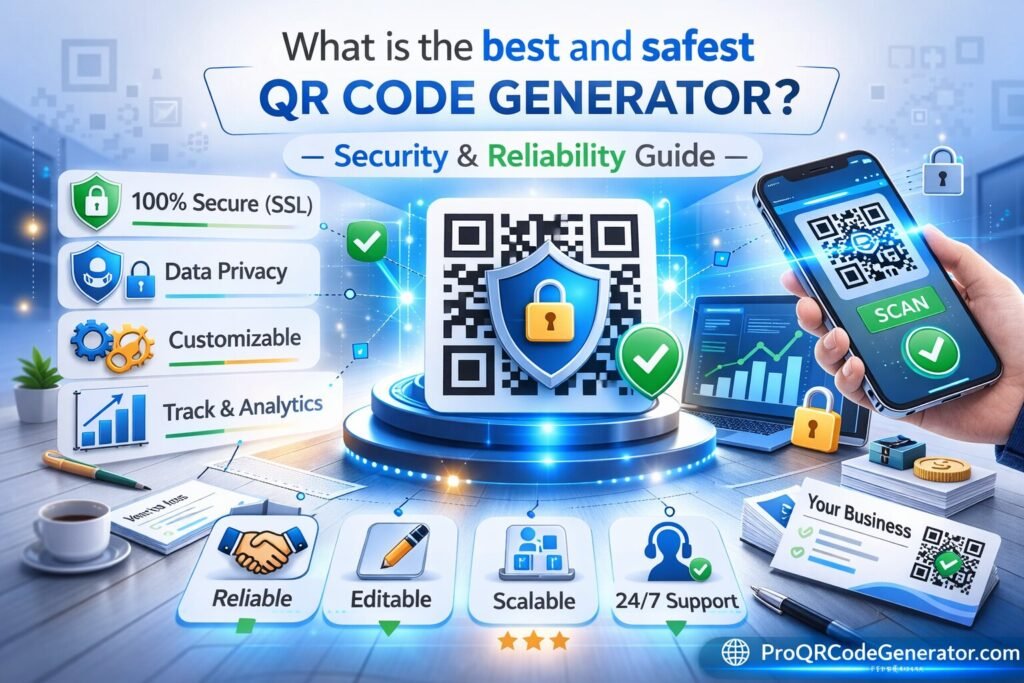
To determine what is the best and safest QR code generator, you must audit platforms against five non-negotiable pillars of digital security.
1. End-to-End SSL/TLS Encryption
A secure generator operates exclusively on HTTPS. When a user scans your code, the initial ping to the routing server and the subsequent redirect to your destination URL must be encrypted via SSL/TLS protocols. This prevents “man-in-the-middle” (MitM) attacks where a hacker intercepts the traffic on a public WiFi network to alter the destination.
2. Dynamic URL Routing and Cloud Security
The safest platforms utilize dynamic architecture (more on this below). Because the routing is handled in the cloud, the platform’s servers must be hardened. Look for providers hosted on enterprise-grade infrastructure (like AWS or Google Cloud) with active DDoS (Distributed Denial of Service) mitigation, ensuring your links stay live even under malicious traffic floods.
3. SOC 2 Compliance and Data Sovereignty (GDPR/CCPA)
If a platform collects scan analytics (location, time, device type), it must adhere to international privacy laws. The safest generators anonymize IP addresses and process data in compliance with GDPR (Europe) and CCPA (California). Furthermore, SOC 2 Type II compliance indicates that the software provider has been audited by a third party for strict data security and operational protocols.
4. Active Threat Monitoring and Anomaly Detection
A professional tool doesn’t just generate a code; it monitors it. Enterprise platforms utilize AI to scan destination URLs for malware. If you accidentally link your QR code to a compromised webpage, a safe generator will detect the threat, flag it in your dashboard, and automatically sever the redirect to protect your customers.
5. Custom Domain Whitelabeling (Domain Spoofing Prevention)
When a user scans a standard QR code, a preview of the URL appears on their screen. If you use a generic platform, the user sees a strange, third-party URL (e.g., qr-free-gen.com/xyz). This trains users to click unknown links. The safest generators allow you to use a custom branded domain (e.g., qr.yourcompany.com). This authenticates the link, proving to the user that the destination is officially sanctioned by your brand.
(For organizations requiring hardened, SOC-compliant routing and custom domain whitelabeling, platforms like ProQRCodeGenerator.com provide the necessary enterprise architecture.)
The Danger of Free Generators: A Cost-Benefit Analysis
The internet is saturated with free QR code generators. From an operational standpoint, using these tools for commercial purposes is a critical error.
Data Harvesting and Reselling
“If the product is free, you are the product.” Many free QR code generators monetize their service by aggressively tracking the users who scan your codes. They harvest device IDs, location data, and browsing habits, which are then bundled and sold to third-party data brokers. By using these tools, you are inadvertently compromising your customers’ privacy.
Ad-Injected Redirects (Brand Hijacking)
To pay for server costs, some free generators utilize “interstitial ads.” When your customer scans your restaurant menu or business card, they are forced to watch a 5-second ad for a competitor before being redirected to your content. This destroys the user experience and severely damages brand equity.
The Catastrophe of Link Rot
Free platforms have no Service Level Agreements (SLAs). They can—and frequently do—delete your links without warning to save server space, or shut down entirely. This results in “link rot.” Any physical collateral bearing that QR code becomes instantly useless, leading to massive financial losses in wasted printing and distribution.
Static vs. Dynamic QR Codes: The Security Perspective
Understanding the difference between static and dynamic data architecture is paramount when searching for the safest solution.
Static Codes: Permanent, Uneditable, Vulnerable
A static QR code permanently mathematically encodes your destination URL directly into the black-and-white pixel pattern.
- The Security Flaw: You have zero control after printing. If your destination URL is compromised, or you need to take a campaign offline due to an emergency, you cannot deactivate a static code. It remains a live, unmonitored portal into your digital ecosystem forever.
Dynamic Codes: Agile, Trackable, Secure
A dynamic QR code encodes a short, secure routing URL (e.g., qr.domain.com/123). When scanned, the user hits the secure routing server, which instantly forwards them to your actual destination.
- The Security Advantage: Because you control the routing server via your dashboard, you possess a “kill switch.” You can change the destination URL at any time, password-protect the link, or instantly deactivate the code if you detect suspicious activity.
Enterprise Security Comparison Matrix
| Security Feature | Free Static Code | Free Dynamic Code | Enterprise Dynamic (Professional) |
| SSL/HTTPS Routing | Usually | Sometimes | Always (Forced) |
| Link Editability | No | Yes (Until expiration) | Yes (Permanent) |
| Kill-Switch / Deactivation | No | No | Yes (Instant) |
| Malware Destination Scanning | No | No | Yes (Automated) |
| Custom Branded Domain | No | No | Yes (Spoofing Prevention) |
| Uptime Guarantee (SLA) | None | None | 99.99% Uptime |
How to Evaluate and Choose the Best and Safest QR Code Generator
Procurement and IT teams must establish a rigorous vetting process. Use this framework to evaluate potential SaaS vendors.
Step 1: Audit the Infrastructure
Ask the vendor where their servers are located. Are they using fragmented, low-cost hosting, or are they backed by tier-one providers? Request their historical uptime data. A safe generator should boast a 99.9% uptime SLA to ensure your campaigns never drop.
Step 2: Review Access Controls (IAM)
If multiple employees use the platform, security breaches often happen internally via compromised employee passwords. The safest QR code generators offer Single Sign-On (SSO) integrations (like Okta or Google Workspace) and Role-Based Access Control (RBAC). This ensures a junior marketer cannot accidentally delete or redirect a mission-critical enterprise code.
Step 3: Analyze Data Collection Policies
Read the vendor’s privacy policy meticulously. The platform should act as a “Data Processor” (handling data strictly on your behalf) rather than a “Data Controller” (owning the data). Ensure they offer PII (Personally Identifiable Information) masking to keep your analytics fully compliant with global privacy legislation.
Industry-Specific Security Applications
The definition of safe varies depending on the regulatory environment of your industry.
Financial Services & Banking
Banks use QR codes for contactless ATM withdrawals and secure document sharing. In this sector, the safest generator must support dynamic password protection. Before the redirect resolves, the user must input a PIN or biometric confirmation, ensuring that even if a code is photographed by a bystander, the payload remains secure.
Healthcare & Pharmaceuticals
Hospitals utilize QR codes on patient wristbands and medication packaging. These codes must route to HIPAA-compliant servers. The generator must ensure that no patient data is cached or stored on the QR routing server during the split-second redirect process.
Consumer Packaged Goods (CPG) & Anti-Counterfeiting
High-end luxury brands use QR codes for product authentication. The safest platforms generate unique, serialized dynamic codes for every single product. If a counterfeiter duplicates one QR code and prints it on 1,000 fake handbags, the anomaly detection system flags the impossible geographic scan volume and instantly invalidates that specific serial number.
Step-by-Step Guide: Deploying a Mathematically Secure QR Campaign
To ensure your next deployment is entirely secure, execute this technical setup sequence:
1. Centralize Your Tooling: Mandate that all departments (Marketing, HR, Sales) use a single, approved enterprise platform like ProQRCodeGenerator.com to prevent “shadow IT” where employees use unsecured free tools.
2. Configure Your Custom Domain (White-Labeling):
In your DNS settings, map a subdomain (e.g., explore.yourbrand.com) to your generator’s routing servers. This provides visual authentication to your users when they scan the code.
3. Set Error Correction to Level M (15%):
While generating the code, utilize the Reed-Solomon error correction matrix. Level M ensures the code is complex enough to resist minor physical tampering (like a small scratch) but clean enough to scan rapidly without failure.
4. Design with the “Quiet Zone”:
Maintain a clear, negative space around the perimeter of the code. This prevents the scanner from confusing surrounding background graphics with the data matrix, reducing scan errors and accidental redirects.
5. Apply Phishing Countermeasures:
Never print a “naked” QR code. Always embed your official corporate logo in the center of the matrix and frame the code with a clear Call-to-Action (e.g., “Scan to view our official site”). This conditions users to only trust codes that bear your visual watermark.
Analytics & Tracking: Gaining Insights Without Violating Privacy
A common misconception is that tracking scan analytics inherently violates user privacy. The safest QR platforms decouple behavioral insights from personal identity.
When you utilize an enterprise platform, you gather aggregated, first-party data:
- Total and Unique Scans: Understand campaign volume.
- Geographic Heatmaps: Track scans down to the city level based on server pings, without capturing exact GPS coordinates.
- Device Operating Systems: Know if your audience uses iOS or Android to optimize your landing pages.
This aggregated data provides deep marketing ROI attribution without ever requesting, storing, or exposing the scanner’s personal name, phone number, or private browsing history.
The ROI of Enterprise QR Security
Executives occasionally balk at paying a subscription fee for something they perceive as a “free graphic.” The ROI of a secure generator is calculated through risk mitigation.
Consider the cost of a data breach, the legal fees associated with a GDPR violation, or the sheer operational cost of reprinting 10,000 product catalogs because a free static link died.
An enterprise QR platform operates as a low-cost insurance policy. By centralizing link management, encrypting traffic, and guaranteeing uptime, the software pays for itself the moment it prevents a single compromised campaign or eliminates the need for a physical reprint.
Crucial Mistakes to Avoid When Generating QR Codes
Even with the best software, human error can create vulnerabilities.
- Ignoring SSL Certificates on the Destination URL: Your QR platform might be secure, but if your final destination website lacks an SSL certificate (HTTP instead of HTTPS), modern smartphone browsers will block the user with a massive red “Warning: Unsafe Site” screen.
- Failing to Audit Old Codes: Companies often leave QR codes on billboards or old YouTube videos active for years. Always routinely audit your dynamic dashboard. If a campaign is over, redirect the code to your current homepage. Never leave a link pointing to a dead or abandoned promotional page.
- Using Shared Logins: Never share a single administrator login across an entire marketing team. If an employee leaves the company, they retain the power to log in and redirect your corporate QR codes. Always use individual, provisioned seats with strict access controls.
Frequently Asked Questions (FAQ)
What is the best and safest QR code generator?
The safest generators are enterprise-grade, dynamic platforms that offer full SSL/TLS encryption, SOC 2 / GDPR compliance, centralized link management, and custom domain white-labeling. They never inject ads or sell user data.
Are free QR code generators safe for business use?
No. Free generators pose severe security risks, including link rot (your links expiring), data harvesting, and the potential for ad-injection or malicious redirects. They are suitable only for personal, temporary use.
How can I tell if a QR code is malicious before scanning it?
Visually, you cannot read the data matrix. However, modern smartphone cameras will display a preview of the destination URL before you tap to proceed. Always check this URL. If it looks like a random string of characters instead of a trusted brand domain, do not open it.
Do dynamic QR codes pose a security risk?
No, dynamic codes actually increase security. Because they are routed through a central server, administrators can instantly update destinations, monitor for threats, or deactivate the code entirely if a physical poster is tampered with.
What is Quishing and how does a safe generator prevent it?
Quishing (QR Phishing) involves tricking users into scanning a fake code. Safe generators prevent this by allowing businesses to use custom branded domains, making it immediately obvious to the user if a hacker has placed a fake sticker over the original code (as the fake URL preview will not match the official brand domain).
Can a QR code hack my phone?
A QR code is simply a piece of stored text (usually a URL). The code itself cannot hack your phone. However, if the code directs you to a malicious website that initiates a malware download, your device can be compromised. This is why secure routing is vital.
Conclusion: Fortifying Your Physical-to-Digital Bridge
As the digital landscape evolves, so do the tactics of malicious actors. Asking what is the best and safest QR code generator is a critical step in modern corporate governance.
A QR code is no longer just a shortcut; it is a gateway to your brand’s digital ecosystem. Treating it with the same rigorous security protocols as your primary website or CRM is not optional—it is a necessity. By rejecting the false economy of free, static tools and embracing dynamic, encrypted, and enterprise-grade architecture, you protect your brand equity and safeguard your customers’ trust.