
Table of Contents
In the modern real estate landscape, the bridge between a physical property and a digital lead is the most critical juncture in the sales funnel. For decades, agents relied on traditional yard signs, printed flyers, and direct mail postcards. While these physical assets are still essential for local brand dominance, they historically suffered from a massive blind spot: zero lead attribution. If a prospective buyer drove past a listing and took a flyer, the agent had no idea until the phone rang.
Today, top-producing brokers have solved the offline-to-online attribution problem. If you want to understand how real estate agents use dynamic qr codes, you must look beyond the simple act of scanning a barcode. Modern agents utilize dynamic routing architecture to capture high-intent buyer leads, track the exact ROI of their print marketing, and update their physical signage in real-time without spending an extra dime on commercial printing.
This comprehensive guide dissects the strategic deployment of trackable QR technology in the housing market. We will explore the technical mechanics of dynamic redirection, detail advanced lead generation workflows, and provide a blueprint for turning static yard signs into interactive data-capture engines.
The PropTech Revolution: Why Static is Not Enough
The real estate industry’s initial adoption of QR technology was flawed. Early adopters relied heavily on free, static QR code generators. While this provided a novel way to share a website, it introduced severe operational liabilities.
The Hidden Costs of Static QR Codes in Real Estate
A static QR code encodes the destination URL directly into its black-and-white visual matrix. Because the link is hard-coded into the image, it is permanent. If an agent prints 50 premium aluminum yard signs with a static QR code pointing to www.123MainSt-Listing.com, that code is forever locked to that specific web address.
When the property sells, the agent has two choices: throw away a highly expensive custom yard sign, or pay a commercial printer to create a custom sticker to cover the old code. Furthermore, static codes offer absolutely zero scan analytics. You cannot track how many buyers interacted with the sign.
Why 2026 Buyers Demand Instant Digital Gratification
Today’s homebuyers are highly educated and digitally native. They do not want to manually type a 30-character URL from a moving car, nor do they want to wait for an agent to email them a floor plan. They expect instant, mobile-optimized access to 3D walk-throughs, property disclosures, and pricing data the second they pull up to the curb. Dynamic architecture delivers this instant gratification while simultaneously capturing the user’s data for the listing agent.
Understanding the Mechanics of Dynamic QR Codes
To fully grasp how real estate agents use dynamic qr codes to outmaneuver their competitors, you must understand the underlying server-side mechanics.
The Power of Redirection: Changing Links Post-Print
Unlike a static matrix, a dynamic QR code encodes a secure, intermediary “short link” (e.g., qr.yourbrokerage.com/sign-01). When a prospective buyer scans the yard sign, their smartphone browser pings this short link.
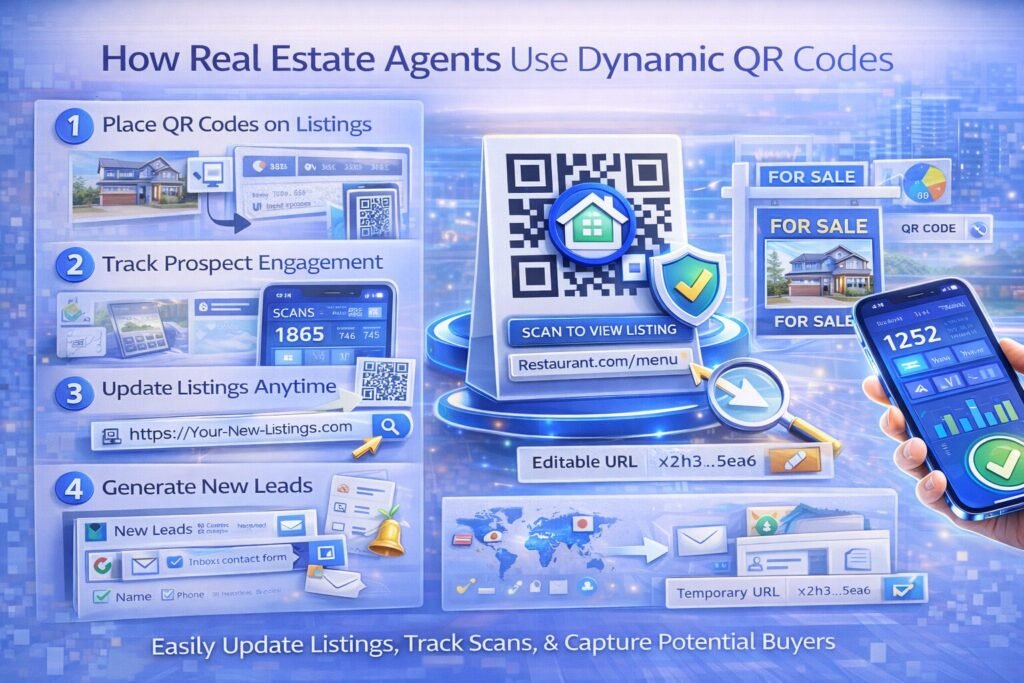
In a fraction of a second, the tracking server intercepts the scan, logs the data, and instantly issues an HTTP 302 (Temporary Redirect) command, pushing the buyer’s phone to your final destination URL. Because the printed yard sign only points to the routing server, you can log into your backend dashboard at any time and change the final destination.
When 123 Main Street sells, you simply log in, change the destination link to your new listing at 456 Elm Street, and move the exact same physical yard sign to the new property. The code updates instantly.
Data Attribution: From Scanned to Sold
Because the scan passes through a central server, the platform captures vital, non-personally identifiable information. Agents can view the exact timestamp of the scan, the geographic region, and the device operating system (iOS vs. Android). This transforms a piece of plastic on a front lawn into a measurable digital asset.
Top 5 Use Cases for Dynamic QR Codes in Real Estate
The versatility of editable codes allows brokers to implement them across every phase of the real estate lifecycle. Here is a breakdown of the most profitable applications.
1. Smart Yard Signs: Beyond the Static Flyer
The classic “take one” flyer box is obsolete. It requires constant refilling, the paper gets ruined in the rain, and it provides zero analytics. Top agents replace the flyer box with a prominent, weather-proof dynamic QR code rider on their yard sign. The code routes directly to a mobile-optimized single-property website featuring high-definition photos, a virtual tour, and an immediate “Contact Agent” button.
2. Open House Sign-ins: Automated Lead Capture
Manual pen-and-paper sign-in sheets at open houses are notorious for illegible handwriting and fake email addresses. Instead, agents place a beautifully branded QR code on a tabletop display at the entryway. The code links to a digital lead capture form. To incentivize the scan, agents offer a value exchange: “Scan here to sign in and instantly receive the comprehensive property disclosure packet and neighborhood comps.” The lead is captured digitally and routed directly into the agent’s CRM.
3. Interactive Direct Mail: Postcards that Track ROI
Real estate farming relies heavily on direct mail, but measuring the ROI of a “Just Sold” postcard campaign has traditionally been a guessing game. By placing a dynamic code on the postcard linking to a home valuation landing page (“Scan to see what your home is worth today”), agents can track exactly how many homeowners engaged with the mailer.
4. Virtual Tours and Augmented Reality (AR) Access
Luxury real estate relies on immersion. For out-of-state or international buyers, physical showings are often impossible. Agents place QR codes on their premium printed brochures that link directly to Matterport 3D walk-throughs or AR staging apps, allowing the buyer to digitally tour the property from their living room.
5. Digital Business Cards: Connecting with High-Net-Worth Clients
Networking is the lifeblood of real estate. Instead of handing over a paper card that ends up in the trash, agents utilize a vCard QR code. When scanned, this code automatically prompts the user’s smartphone to save the agent’s name, phone number, email, website, and headshot directly into their native contacts app.
How Real Estate Agents Use Dynamic QR Codes for Lead Generation
Traffic without conversion is merely vanity. The most successful brokers design their QR campaigns specifically to capture high-intent buyer and seller leads.
Integrating QR Codes with CRM Workflows
When examining how real estate agents use dynamic qr codes effectively, the secret lies in CRM integration. When a buyer scans a code on a yard sign, they are directed to a landing page with a Facebook Pixel or Google Analytics tracking code installed. Even if the buyer doesn’t fill out a form immediately, they are now “pixeled.” The agent can then serve highly targeted retargeting ads to that specific buyer across social media platforms, keeping the property top-of-mind.
Using WhatsApp and SMS QR Types for Instant Contact
Real estate is a speed-to-lead game. If a buyer has a question while standing outside a property, they don’t want to fill out a web form and wait 24 hours. Advanced dynamic platforms allow agents to create specialized WhatsApp or SMS QR codes.
When scanned, these codes instantly open the buyer’s native messaging app with a pre-filled text message: “Hi, I’m outside your listing at 123 Main St and I’d like to schedule a private showing.” The buyer just hits send, creating an instant, frictionless communication channel.
Analyzing the Data: Tracking Scan Analytics for Listing Presentations
Winning a listing presentation against a competing broker requires more than just a charming personality; it requires data-backed proof of your marketing prowess.
Showing Sellers the Data: Proving Your Marketing Reach
Imagine sitting at a seller’s dining room table. The competing agent promises to “put a sign in the yard.” You, however, open your tablet and show the seller a dashboard. You explain, “For my last listing in this neighborhood, my smart yard sign generated 142 unique scans in the first weekend. Of those scans, 28 people clicked through to view the virtual tour, and 4 requested private showings directly from the sign.” Providing concrete engagement metrics proves to the seller that your marketing strategy is active, measurable, and highly effective. Professional tools like ProQRCodeGenerator.com provide these clean, client-ready analytics dashboards that elevate your perceived value as a data-driven marketer.
Geographic and Device Insights
If you run a luxury print ad in a national magazine featuring a QR code for a high-end listing, dynamic tracking allows you to see the geographic origin of the scans. If you notice a high concentration of scans coming from New York or California, you can adjust your digital ad spend to heavily target those specific out-of-state relocation markets.
Step-by-Step Guide: Setting Up a Dynamic Real Estate Campaign
Transitioning your marketing to a trackable digital infrastructure is a straightforward process when utilizing the right software stack.
Step 1: Choose a Professional Infrastructure
Avoid free internet tools. Select a business-grade SaaS platform built for high-volume routing. You need a platform that guarantees 99.9% uptime, as a broken link on a Sunday afternoon yard sign costs you commissions.
Step 2: Generate the Campaign Link
Inside your dashboard, create a new dynamic code. Paste the URL of your single-property website, your Matterport tour, or your lead capture form.
Step 3: Design for Luxury Brand Identity
A generic, unbranded black-and-white square looks cheap. Use the platform’s design suite to customize the code. Match the matrix color to your brokerage’s branding (e.g., navy blue or metallic gold). Most importantly, embed your headshot or your brokerage’s logo directly into the center of the code. This assures the buyer that the link is safe and professional.
Step 4: Add a Conversion-Focused CTA Frame
Never print a naked QR code. Wrap the code in a frame that features a clear Call to Action (CTA). Examples include:
- “Scan for Price & 3D Tour”
- “Scan to See Inside”
- “Scan for Neighborhood Comps”
Step 5: Export in Vector Format
When sending your design to a commercial printer for yard signs or large banners, you must download the code in a high-resolution vector format (SVG or EPS). If you use a standard PNG or JPEG and stretch it to fit a large sign, the image will pixelate, and smartphone cameras will fail to read it.
For agents looking to streamline this exact process, ProQRCodeGenerator.com offers dedicated tools for customizing, exporting, and managing dozens of active listing codes simultaneously.
ROI Discussion: Subscription vs. The Cost of Lost Leads
Many agents hesitate to adopt new software subscriptions, questioning the monthly cost. However, the ROI of dynamic routing in real estate is mathematically undeniable.
Consider the cost of traditional marketing:
- 10 Custom Aluminum Rider Signs: $250
- 1,000 Just Listed Postcards + Postage: $600
- Total Investment: $850
If you use static codes on these materials, and the property sells in 14 days, those materials are instantly obsolete. The $850 is a sunk cost. Furthermore, if the static URL breaks or changes, the materials are ruined before they even hit the market.
By utilizing a premium dynamic platform (typically costing $20-$40 per month), those 10 custom rider signs become reusable assets. When the home sells, you update the backend link to your next listing. The signs are infinitely reusable, saving you hundreds of dollars in printing costs per quarter. More importantly, capturing just one unrepresented buyer lead from a smart sign that results in a transaction pays for the software subscription for the next decade.
Comparison: Static vs. Dynamic QR for Realtors
To fully contextualize how real estate agents use dynamic qr codes as a superior technology, review this direct capability comparison.
| Capability / Feature | Static QR Code | Dynamic QR Code |
| Change Link After Printing | No (Requires Reprint) | Yes (Instant Backend Update) |
| Track Scan Volume & Time | No (Blind Marketing) | Yes (Real-time Analytics) |
| Track Geographic Location | No | Yes (City/Region Level) |
| A/B Testing Landing Pages | Impossible | Easy (Swap URLs instantly) |
| Scannability / Speed | Slows down with long URLs | Lightning fast (Uses Short URL) |
Common Mistakes and How to Avoid Them
Even with elite technology, poor execution will kill your conversion rates. Avoid these common pitfalls:
1. Low-Resolution Prints and Scanning Failures
If you download a low-quality JPEG of your QR code and blow it up to fit a 24×36 inch A-Frame sign, the edges of the data matrix will blur. A blurred code cannot be read by a phone’s camera. Always provide your printer with crisp, scalable SVG or EPS vector files.
2. The Dead Link Problem in Real Estate
When a property goes under contract or is sold, many agents simply delete the single-property website. If a buyer drives by the sign a week later and scans the code, they hit a 404 Error page.
The Fix: When a property sells, do not delete the link. Instead, log into your dynamic dashboard and redirect that specific QR code to a landing page that says: “Sorry, this property just sold! Scan below to view similar available homes in this neighborhood, or contact me to find your dream home.” You turn a dead end into a new lead opportunity.
3. Ignoring Mobile Optimization
The entire point of a QR code is that it will be scanned by a mobile device. If your QR code links to a desktop-formatted PDF flyer that forces the user to pinch, zoom, and scroll sideways to read the property details, they will bounce immediately. Ensure your destination links are flawlessly responsive for iOS and Android screens.
Security and Trust in Real Estate Tech
As digital real estate transactions increase, so do security threats. “Quishing” (QR Phishing) involves malicious actors placing fake QR stickers over legitimate signs to route users to spam sites.
To protect your brand reputation:
- Brand Your Codes: Always put your logo in the center of the code. It is much harder for a scammer to replicate a highly branded, color-matched code.
- Use Secure Platforms: Ensure your QR provider utilizes enterprise-grade SSL/TLS encryption. ProQRCodeGenerator.com ensures all routing URLs are secure, preventing digital interception and maintaining the trust of your high-net-worth clientele.
- Physical Deterrents: Print your codes directly onto the metal or plastic of your signs rather than using cheap stickers that can be easily peeled off or covered.
Frequently Asked Questions (FAQ)
Are QR codes still relevant for real estate in 2026?
Absolutely. They have evolved from a novelty into a foundational PropTech tool. They are the fastest, most frictionless way to bridge physical marketing (signs, mailers) with digital assets (virtual tours, lead forms).
How do I create a QR code for a property listing?
Use a professional dynamic QR code generator. Paste the URL of your property listing, customize the design to match your brokerage branding, download the vector file, and add it to your print marketing.
Can I change the link on a QR code after the sign is printed?
Yes, but only if you generated a Dynamic QR code. Static codes cannot be changed. Dynamic codes allow you to edit the destination URL infinitely via a backend dashboard without touching the physical sign.
Do dynamic QR codes track the location of the person scanning?
They track the IP address of the scanning device, which provides an approximate geographic location (city or region level). They do not track precise GPS coordinates, ensuring consumer privacy compliance.
What is the difference between static and dynamic QR codes for realtors?
Static codes encode a permanent link directly into the image and offer no tracking. Dynamic codes use a routing server, allowing the agent to change the final link at any time and gather detailed scan analytics.
How do I use QR codes for virtual home tours?
Generate a dynamic QR code that links directly to your Matterport, Zillow 3D Home, or custom AR tour link. Place this code prominently on your premium brochures and yard signs.
Can I see how many people scanned my real estate yard sign?
Yes. When using a dynamic platform, your dashboard will display total scans, unique visitors, and the exact times and dates the scans occurred.
How to capture leads using QR codes at an open house?
Place a QR code on a stand at the front door linking to a digital sign-in form (like Google Forms or your CRM’s landing page). Require name and email to instantly unlock the property disclosures.
Do QR codes work on real estate postcards?
Yes. They are the best way to track the ROI of direct mail. Link the postcard code to a free home valuation tool to capture seller leads.
What is the best QR code generator for real estate agents?
The best platforms offer dynamic routing, vector downloads, deep analytics, and custom branding. Solutions like ProQRCodeGenerator.com are built specifically for the high-volume, professional needs of real estate businesses.
How to update a “Sold” sign QR code to a new listing?
Log into your dynamic QR dashboard, locate the campaign for the sold property, click edit, delete the old listing URL, and paste the URL for your newest listing. The physical sign updates instantly.
Are QR codes on business cards effective for agents?
Highly effective. By using a vCard QR code, a scan instantly prompts the user’s phone to save all your contact details directly into their address book, eliminating the friction of manual data entry.
Can I link a QR code directly to a WhatsApp chat?
Yes. You can generate a specific WhatsApp QR code that, when scanned, opens the user’s app with a pre-written message directed to your phone number, facilitating instant communication.
How to integrate QR codes with real estate CRMs?
Link your dynamic QR code to a landing page hosted by your CRM (like Follow Up Boss, KVCore, or Hubspot). When the user fills out the form on that page, the lead automatically populates in your database.
Do real estate QR codes need to be in high resolution?
Yes. For large format printing like yard signs or billboards, you must use high-resolution vector files (SVG or EPS). Standard JPEGs will blur when enlarged, making them unscannable.
Conclusion: Future-Proofing Your Real Estate Brand
The real estate market rewards speed, data, and efficiency. When you master how real estate agents use dynamic qr codes, you stop relying on hope-based marketing. You move away from crossing your fingers and hoping someone takes a paper flyer, and instead transition to a measurable, data-driven digital ecosystem.
By deploying dynamic infrastructure, you drastically reduce your commercial printing overhead, capture higher-intent buyer leads right from the curb, and gain the concrete analytical data required to win high-end listing presentations. The physical yard sign is no longer just a marker; it is an active lead generation portal.
Don’t let your marketing materials die the moment a property goes under contract. Take control of your offline attribution and build a smarter, more agile real estate brand.