
Table of Contents
In the fiercely competitive real estate industry, print marketing remains a foundational pillar of local brand dominance. However, traditional print media has historically suffered from a massive structural flaw: the inability to measure direct lead attribution. Brokers and agents spend thousands of dollars annually on glossy brochures, Just Listed postcards, and open house handouts, yet when a property sells, it is nearly impossible to determine which specific piece of paper generated the buyer.
The days of “blind” print marketing are over. Today’s top-producing real estate professionals bridge the gap between physical paper and digital data by implementing dynamic routing architecture. If you want to transform a static piece of paper into an interactive lead-capture device, you must understand how to deploy a trackable qr code for property flyers.
This comprehensive guide breaks down the technical mechanics of dynamic QR tracking, explores the exact workflows used by elite brokerages to capture high-intent buyer leads, and provides a step-by-step blueprint for future-proofing your real estate marketing campaigns.
What It Is: The Evolution of the Trackable QR Code for Property Flyers
To understand the strategic value of this technology, you must first recognize the fundamental difference between standard barcodes and dynamic tracking architecture.
The Death of the “Blind” Printed Flyer
For years, agents utilized free internet tools to generate static QR codes for their listings. A static code permanently encodes your exact website URL (such as www.yourbrokerage.com/123-main-street) directly into the black-and-white visual matrix.
This creates two massive liabilities for real estate agents. First, static codes offer zero analytics; you have no idea if the code on your flyer was scanned once or a thousand times. Second, if the property goes under contract or the URL changes, the physical flyer becomes instantly obsolete. The printed code breaks, resulting in a frustrating “404 Error” for the prospective buyer.
Defining Trackable Dynamic Architecture
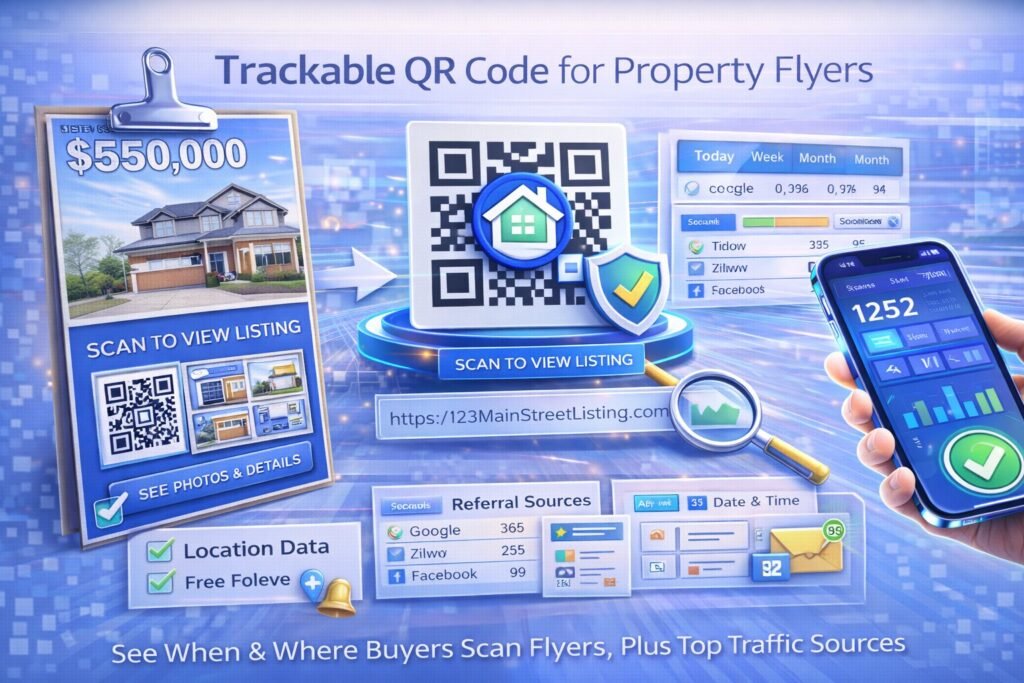
A trackable qr code for property flyers utilizes dynamic routing. Instead of encoding the final destination link, a dynamic code encodes a permanent, secure “short URL.” When a buyer scans the flyer, they are momentarily routed through a management server before landing on your property listing.
Because the printed matrix only points to the tracking server, you maintain absolute control over the final destination. You can log into your dashboard and change the link behind the QR code an infinite number of times without ever reprinting the physical flyer. Simultaneously, the server logs every single interaction, providing you with actionable marketing data.
How It Works: The Server-Side Redirection Mechanism
For marketing directors and agents transitioning into data-driven PropTech, understanding the backend process of this technology is crucial. When a prospective buyer picks up your flyer and scans the dynamic code, a highly sophisticated sequence occurs in roughly 150 to 300 milliseconds.
- The Scan: The buyer’s smartphone camera decodes the matrix and opens their mobile browser, pinging the short routing URL.
- The DNS Lookup: The browser locates the IP address of the routing server hosted by your QR platform.
- Data Capture (Analytics): The routing server receives the request. In this fraction of a second, it captures non-personally identifiable analytics, including the timestamp, device operating system, and general geographic location based on the IP address.
- The HTTP 302 Redirect: The server queries its database to see which property link you currently have set as active. It then issues an HTTP 302 (“Temporary Redirect”) status command to the smartphone, pushing it seamlessly to your active listing.
- The Final Load: The mobile browser automatically follows the redirect and loads your single-property website, Matterport 3D tour, or lead capture form.
By utilizing an enterprise-grade platform like ProQRCodeGenerator.com, this multi-step relay happens frictionlessly. The buyer experiences zero lag, and your CRM captures the data instantly.
Core Benefits for Real Estate Agents
Transitioning your brokerage’s print collateral to dynamic infrastructure provides immediate, measurable benefits to your Gross Commission Income (GCI) and your daily operations.
Eliminating Print Waste with Editable Destinations
High-quality, heavy-stock property flyers are expensive. In a fast-moving market, a property might go from “Active” to “Pending” in 48 hours. If you printed 500 flyers with a static code, 450 of them might end up in the recycling bin.
When you use a trackable qr code for property flyers, you eliminate this waste. When the house goes under contract, you simply log into your software dashboard and redirect the QR code to a new landing page that states: “This property is under contract! Scan here to view similar available homes in this neighborhood.” Your leftover flyers instantly become lead-generation tools for other listings.
Instant Lead Capture and CRM Routing
Traffic without conversion is merely vanity. The primary benefit of a trackable code is its ability to integrate with your existing sales funnel. By linking your dynamic QR code to a mobile-optimized landing page with a lead capture form, you force engagement. If a buyer wants to view the floor plans or the disclosures, they input their email address. That data is instantly routed into your CRM (like Follow Up Boss or KVCore), triggering an automated text message or email drip campaign while the buyer is still standing in the driveway.
Business Applications for Trackable Property Codes
How do top-tier real estate groups leverage this technology? They use it to implement advanced, data-driven revenue strategies across multiple touchpoints.
Open House Sign-In Automation
Traditional pen-and-paper sign-in sheets at open houses result in illegible handwriting and fake phone numbers. Elite agents replace the clipboard with a heavy acrylic stand featuring a custom-branded QR code. As buyers enter, the agent instructs them to “Scan the code to sign in and instantly receive the property disclosure packet to your phone.” This value exchange guarantees accurate contact information and logs the exact time the buyer toured the home.
Neighborhood Farming and Direct Mail
Farming a specific subdivision requires consistent direct mail. By placing a trackable code on a “Just Sold” postcard, you can measure the exact ROI of your postage spend. If you send 1,000 postcards offering a free home valuation, the tracking analytics will tell you exactly how many homeowners scanned the card, what day they scanned it, and whether the campaign was profitable.
Commercial Real Estate Window Displays
For commercial brokers leasing retail or office space, window displays are critical. A massive, high-resolution trackable code placed in the storefront window allows pedestrians to instantly download the offering memorandum, zoning details, and pricing structure without having to call the broker’s office during the weekend.
Real-World Industry Examples
To truly conceptualize the value of this technology, consider how different sectors of the real estate industry apply dynamic updates.
- The Luxury Broker’s Multi-Unit Campaign: A developer selling a 50-unit luxury condo building prints a single, high-end lookbook for prospective buyers. Instead of printing prices (which fluctuate based on demand), the broker includes a trackable qr code for property flyers labeled “Scan for Current Availability and Pricing.” The broker updates the backend digital spreadsheet daily. The printed lookbook remains accurate for the entire two-year sales cycle.
- The Solo Agent’s “Just Sold” Pipeline: An independent agent closes a home above the asking price. They blanket the neighborhood with door hangers featuring a QR code linking to a video breakdown of how they negotiated the deal. The analytics dashboard reveals that 45 neighbors scanned the code on a Sunday afternoon, allowing the agent to target that specific geographic radius with digital Facebook ads the very next day.
(Looking to implement these exact strategies? You can generate, customize, and track these campaigns effortlessly using ProQRCodeGenerator.com as your central marketing hub.)
Step-by-Step Guide: Creating Your Trackable QR Code for Property Flyers
If you are currently locked into a static, untrackable system, you must migrate to a professional dynamic platform. Here is the exact, step-by-step process for deploying a high-converting real estate campaign.
Step 1: Secure Your Digital Destination
Before generating the code, ensure your digital asset is ready. This should be a mobile-responsive single-property website, a Zillow 3D Home tour, or an unlisted YouTube video walk-through. Ensure the page loads in under three seconds on a cellular connection.
Step 2: Generate and Brand Your Code
Log into your professional QR management dashboard. Select the option to create a “Dynamic URL” code. Paste your property link. Next, use the design suite to customize the aesthetics. Real estate is a visual business; your QR code must look premium. Match the matrix color to your brokerage’s branding (e.g., Keller Williams red or Coldwell Banker blue). Crucially, upload your headshot or your brokerage logo directly into the center of the code to build instant trust with the scanner.
Step 3: Add a Conversion Frame
Do not print a naked square. Enclose the QR code in a design frame that features a clear Call to Action (CTA). The text should tell the buyer exactly what they get for scanning. Excellent real estate CTAs include:
- “Scan for Price & 3D Tour”
- “Tap Here for Floor Plans”
- “Scan to Schedule a Private Showing”
Step 4: Export in High-Resolution Vector Format
This is the most critical step for print marketing. When downloading your code, never use a low-resolution PNG or JPEG for commercial printing. Download the file as an SVG or EPS vector. Vector files can be scaled to the size of a billboard without ever losing clarity, ensuring your code scans instantly on glossy flyer paper.
Step 5: Test and Deploy
Open your smartphone camera (and have a colleague use a different operating system) to scan the code on a test print. Ensure the redirect is instantaneous and the destination page is properly formatted for mobile screens before ordering 1,000 copies from the print shop.
Comparison Section: Static vs. Dynamic Flyer Codes
To ensure you make the correct infrastructural choice for your real estate business, review this direct capability comparison.
| Marketing Capability | Free Static QR Code | Dynamic Trackable QR Code |
| Edit URL After Printing | Impossible. Must reprint. | Instant via backend login. |
| Track Scan Volume & Time | None. Completely blind. | Full real-time analytics. |
| Geographic Location Data | No tracking available. | Tracks region/city of the scanner. |
| Update “Sold” Properties | Breaks (404 Error). | Redirects to new active listings. |
| Print Quality/Resolution | Often low-res JPEGs. | High-fidelity Vector (SVG/EPS). |
Analytics & Tracking: Decoding the Buyer’s Journey
When you utilize dynamic architecture to solve the problem of offline attribution, you unlock one of the most powerful tools in modern real estate: behavioral data.
Measuring Peak Engagement Times
Your dashboard will reveal a timeline of scan frequency. While you may intuitively know when your open house is busy, scan data shows you exactly when buyers are reviewing your flyers later in the evening. If your analytics show a massive spike in scans on Tuesday nights at 8:00 PM, you know exactly when to launch your digital retargeting ads or send your email newsletters for maximum open rates.
Device Demographics (iOS vs. Android)
Are your prospective buyers using iPhones or Android devices? If your analytics show that 85% of your scans come from iOS devices, you must rigorously QA test your property landing pages, Matterport tours, and CRM lead forms specifically in the mobile Safari browser to ensure a frictionless user experience.
Geographic Hotspots
If you mail property flyers to out-of-state feeder markets (e.g., mailing Florida luxury listings to New York residents), dynamic tracking allows you to see the exact geographic origin of the scans. This proves to your seller that your out-of-state marketing dollars are actually reaching potential buyers in the target demographic.
(With a platform like ProQRCodeGenerator.com, all of these data points are automatically aggregated into clean, client-ready dashboards that you can screenshot and include in your listing presentations to prove your marketing dominance.)
ROI Discussion: The True Cost of Un-Tracked Print Marketing
Many independent agents hesitate to pay a monthly subscription for PropTech software, assuming that “free” static generators save them money. A basic financial analysis proves this is a fallacy.
The Cost of Rigid Print:
Imagine a mid-sized team managing 10 active listings. They print premium property flyers for sign riders and open houses, costing roughly $150 per listing.
- Initial print cost: $1,500.
- Three properties undergo price reductions, requiring emergency reprints: $450.
- Four properties sell quickly, rendering the remaining flyers useless: Sunk cost.Total Cost: $1,950 (plus zero actionable data captured).
The ROI of Dynamic Infrastructure:
A professional platform subscription might cost $20 to $40 a month.
- Annual Subscription: ~$360.
- Initial Print of Dynamic Flyers: $1,500.
- Subsequent updates (price drops, status changes, redirection to new listings): $0.Total Cost: ~$1,860.
In this scenario, deploying a trackable qr code for property flyers saves the team money on direct print costs. More importantly, if the trackable codes capture just one unrepresented buyer lead over the course of the year that results in a standard 3% commission on a $500,000 home ($15,000), the ROI of the software subscription is a staggering 4,000%.
Mistakes to Avoid When Printing Real Estate QR Codes
The ability to track physical media on the fly is powerful, but it must be executed correctly to maintain a premium brand image. Avoid these common digital marketing pitfalls:
1. Sizing and Placement Errors
A QR code printed too small cannot be read by a smartphone camera. For a standard 8.5×11 inch property flyer, the QR code should be no smaller than 1.5 x 1.5 inches. Furthermore, do not place the code too close to the edge of the paper where it might be cut off by the printer’s bleed lines, or in the physical fold of a bi-fold brochure.
2. The Naked Code (Forgetting the CTA)
Dropping a black-and-white square onto a flyer without context is a wasted opportunity. Consumers need to be told why they should pull out their phone. Always use a CTA frame. If the buyer doesn’t know that scanning the code will give them instant access to the property disclosures or the 3D tour, they simply won’t scan it.
3. Uploading Massive Desktop PDFs
If your dynamic code links directly to a PDF file rather than a web page, ensure the PDF is compressed and optimized for mobile viewing. If a buyer standing in a driveway on a weak 4G connection tries to download a 35MB print-ready brochure, the page will time out, and you will lose the lead.
Optimization Tips for Higher Scan Rates
To maximize the scan rate of your flyers and capture the highest volume of buyer data, integrate these advanced optimization strategies.
- High Contrast Design: Smartphone cameras rely on contrast to decode the matrix. Always use a dark-colored QR code on a light-colored background. Never print a yellow QR code on a white background, or a black code on a dark navy background.
- Incentivize the Scan: Offer something the buyer cannot get just by looking at the piece of paper. Text like “Scan for exclusive neighborhood school ratings and recent comps” provides high value and drives massive engagement.
- A/B Testing: Create two different property flyers with two distinct dynamic codes. Distribute Flyer A to one half of a neighborhood, and Flyer B to the other half. Check your analytics dashboard to see which design, headline, or CTA generated a higher scan volume.
Security Considerations for Digital Property Links
As digital real estate transactions become the norm, security threats have evolved. The most prominent threat to real estate agents using QR codes is “Quishing” (QR Phishing).
What is Quishing?
Quishing occurs when a malicious actor prints their own static QR codes on sticker paper. They visit your open house or walk up to your yard sign and secretly place their fake sticker directly over your legitimate QR code. When the next buyer scans the flyer, they are routed to a fake website designed to steal their data or install malware.
How to Protect Your Brokerage
Because you are using professional dynamic infrastructure, you can implement safeguards:
- Brand the Matrix: A scammer will usually print generic black-and-white squares. If your trackable qr code for property flyers features your brokerage logo embedded in the center and is color-matched to your branding, a cheap sticker placed over it will look immediately suspicious to the consumer.
- Use Secure Hosting: Ensure your dynamic QR provider utilizes enterprise-grade SSL/TLS encryption for all their routing URLs (HTTPS). This guarantees that when a buyer scans your code, the connection between their phone and your real estate website is secure and encrypted.
Frequently Asked Questions (FAQ)
What is a trackable QR code for property flyers?
It is a dynamic QR code that uses an intermediary routing server. Instead of linking directly to a website, it tracks the user’s scan data (time, device, location) before instantly redirecting them to your active property listing or lead capture form.
Can I change the link on my property flyer after it is printed?
Yes, but only if you generated a dynamic code. You can log into your software dashboard and update the destination URL instantly without needing to reprint the physical flyer.
Do QR codes on real estate flyers actually get scanned?
Yes, scan rates have skyrocketed post-2020. Modern homebuyers expect instant access to digital floor plans, 3D tours, and pricing. A well-placed QR code with a clear Call to Action is the fastest way to deliver that information.
What analytics can I track from my property flyers?
Professional platforms track the total number of scans, unique visitors, the exact time and date of the scan, the device operating system (iOS/Android), and the geographic region based on the scanner’s IP address.
How do I make a QR code with my brokerage logo in it?
You need to use a premium QR code generator. During the creation process, the software will provide a design suite where you can upload your headshot or logo, change the matrix colors, and adjust the shape of the data points.
Are dynamic QR codes expensive for real estate agents?
No. Most professional SaaS platforms cost between $15 and $40 per month. The cost is negligible compared to the money saved by not having to reprint obsolete marketing materials when a property sells.
What format should I download my QR code in for printing?
For commercial printing on glossy flyers or large yard signs, always download your QR code as a vector file (SVG or EPS). This ensures the code will never pixelate or blur, regardless of how large you print it.
Can I link a QR code directly to a WhatsApp chat with the agent?
Yes. You can generate a specific WhatsApp QR code. When the buyer scans the flyer, it instantly opens their WhatsApp application with a pre-filled message (e.g., “I’m interested in 123 Main St.”) directed to your phone number.
How do I fix a broken QR code on my real estate flyer?
If you used a free static code, you cannot fix it; you must reprint the flyers. If you used a dynamic code, simply log into your dashboard, locate the campaign, and update the destination URL to a working web address.
How small can a QR code be on a property flyer?
To ensure reliable scanning across all smartphone cameras, a QR code on a standard letter-sized flyer should be no smaller than 1.5 x 1.5 inches (roughly 3.8 x 3.8 cm).
What happens to my dynamic QR codes if a property sells?
Do not delete the code! Log into your dashboard and redirect the URL from the sold property’s website to a new active listing, or to a landing page offering a free home valuation for potential sellers.
Is it safe for buyers to scan real estate QR codes?
Yes, provided the agent uses a secure, enterprise-grade QR platform that utilizes HTTPS encryption and the agent ensures their physical flyers have not been tampered with by third parties.
Do I need a separate QR code for every single property flyer?
Yes. To accurately track which property is generating the most interest, you should generate a unique dynamic QR code for each specific listing in your portfolio.
Can a QR code automatically save my contact info to a buyer’s phone?
Yes. By generating a vCard QR code and printing it on your flyers or business cards, a single scan will prompt the buyer’s smartphone to save your name, number, email, and headshot directly into their contacts app.
What is the best software to create trackable QR codes for real estate?
The best platforms offer unlimited dynamic routing, high-resolution vector downloads, custom branding, and granular scan analytics. Platforms built for business use cases provide the reliability and uptime required by top-producing agents.
Conclusion: Transforming Paper into Data Portals
The real estate market moves at lightning speed, and static, unmeasurable marketing strategies are no longer sufficient to maintain a competitive edge. When you deploy a trackable qr code for property flyers, you are fundamentally upgrading your brokerage’s operations. You are transforming flat pieces of paper into interactive data portals that bridge the physical and digital worlds.
By abandoning free, blind generators and embracing professional dynamic infrastructure, you eliminate costly print waste, capture high-intent buyer leads instantly, and acquire the hard data necessary to prove your marketing ROI to discerning sellers.
Stop guessing how well your print marketing is performing. Take total control of your offline-to-online lead attribution and build a smarter, more agile real estate business.