
Table of Contents
QR codes are widely adopted across industries—from retail and restaurants to manufacturing, healthcare, education, and events. They connect offline experiences to digital assets in seconds. But despite their convenience and popularity, QR codes are not flawless.
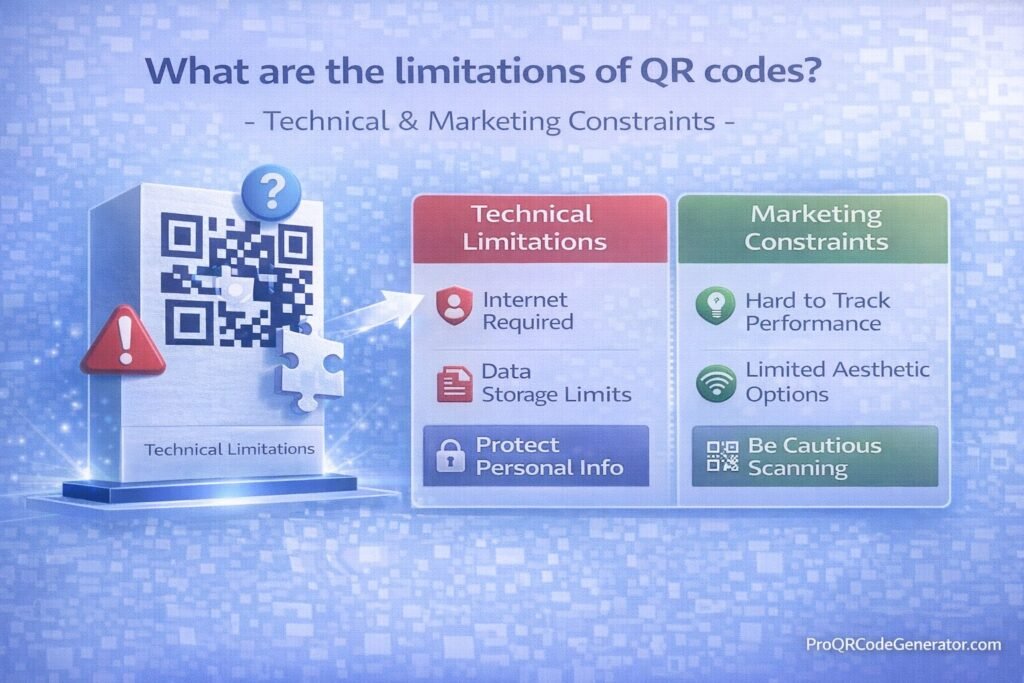
Understanding what are the limitations of QR codes? – Technical & Marketing Constraints is essential for businesses planning scalable campaigns, marketers measuring ROI, and organizations seeking secure deployment.
QR codes offer efficiency—but they also carry structural, technical, behavioral, and marketing constraints. When overlooked, these limitations reduce performance, harm brand perception, and increase operational risk.
This comprehensive guide breaks down every major limitation—from data capacity and scannability issues to analytics blind spots and campaign fatigue—along with mitigation strategies for professional use.
Understanding the Core Architecture of QR Codes
Before examining limitations, it is important to understand how QR codes function.
A QR code:
- Encodes data into a two-dimensional matrix
- Stores alphanumeric characters, URLs, or structured data
- Requires a scanning device with camera capability
- Often triggers automatic browser redirection
QR codes are static visual carriers of encoded information. Once printed or deployed, their functionality depends entirely on the underlying destination and infrastructure.
This design simplicity is powerful—but it introduces constraints.
Technical Limitations of QR Codes
1. Limited Data Storage Capacity
QR codes cannot store unlimited information.
Maximum Data Limits (Approximate):
- Numeric: ~7,000 characters
- Alphanumeric: ~4,000 characters
- Binary: ~3,000 bytes
- Kanji: ~1,800 characters
The more data embedded:
- The denser the code becomes
- The more complex the pattern
- The harder it becomes to scan
For marketing purposes, embedding long URLs directly inside a static QR code increases density and reduces reliability.
Mitigation Strategy:
Use short URLs or dynamic redirect systems instead of embedding large datasets directly.
2. Scannability Issues
QR codes require proper:
- Contrast
- Size
- Quiet zone (white border)
- Print quality
- Lighting conditions
Common Scannability Constraints:
- Low contrast color combinations
- Excessive logo overlays
- Poor print resolution
- Surface glare
- Wrinkled materials
- Too-small codes on packaging
A QR code printed at 1 cm on a billboard is ineffective. Likewise, a stylized QR code with heavy branding may fail to scan.
Rule of thumb:
Minimum scanning distance = QR code size × 10
If your QR code is 2 cm wide, it should be scannable from 20 cm away.
3. Static QR Codes Cannot Be Edited
One of the most critical technical limitations is immutability.
With static QR codes:
- The destination URL is permanently embedded
- You cannot update it after printing
- If the page breaks, the code fails
- If the link changes, reprinting is required
For campaigns involving:
- Packaging
- Billboards
- Flyers
- Product manuals
- This becomes costly and operationally rigid.
Dynamic QR code systems eliminate this constraint by allowing post-print editing. Platforms such as ProQRCodeGenerator.com provide editable redirect layers, enabling businesses to update links without replacing physical materials.
4. No Native Analytics in Basic QR Codes
A QR code image itself:
- Does not track scans
- Does not log user behavior
- Does not measure conversions
Analytics only exist if:
- A tracking-enabled URL is used
- A redirect system logs scan data
Without tracking infrastructure, marketers face:
- No attribution data
- No location insights
- No device breakdown
- No performance metrics
This severely limits campaign optimization.
5. Dependency on Internet Connectivity
Most QR codes redirect to web content. This means:
- Users must have internet access
- Weak signals reduce conversion rates
- Underground or rural environments limit usability
Offline QR codes can store data (like contact cards), but marketing campaigns typically rely on live web pages.
6. Device Compatibility Constraints
While modern smartphones support QR scanning natively, limitations include:
- Older devices lacking camera support
- Broken camera lenses
- Enterprise device restrictions
- App permission limitations
Although adoption is high, QR accessibility is not universal.
7. Security Vulnerabilities
QR codes themselves are neutral—but they can:
- Conceal malicious links
- Redirect to phishing pages
- Trigger malware downloads
This security ambiguity creates user hesitation.
As awareness of QR phishing grows, some users avoid scanning unfamiliar codes—reducing engagement.
8. Print Quality Degradation
QR codes degrade over time:
- Faded ink
- Weather damage
- Scratches
- Dirt accumulation
- Packaging distortion
Environmental exposure reduces reliability in:
- Outdoor signage
- Industrial environments
- Long-term packaging use
Marketing Limitations of QR Codes
Technical constraints are only part of the picture. Marketing limitations are equally important.
9. Lack of Visual Context
A QR code is visually abstract.
Without context, users may ask:
- What will I get?
- Is this safe?
- Is this worth my time?
Low-context QR placement reduces scan motivation.
Example:
A plain QR code on a poster vs.
A QR code with “Scan to get 20% off instantly”
The difference in conversion rate can be significant.
10. User Trust Barriers
Users cannot see where a QR code leads before scanning.
This opacity creates:
- Hesitation
- Security concerns
- Reduced scan rates
Trust signals—like brand alignment, secure landing pages, and recognizable domains—are essential to overcome this limitation.
11. Overuse & QR Fatigue
Post-pandemic adoption led to saturation.
Users now encounter QR codes everywhere:
- Restaurant tables
- Event tickets
- Retail stores
- Product packaging
- Public transport
- Advertisements
Overexposure reduces novelty and urgency.
QR codes are effective—but not inherently compelling.
12. No Built-In Personalization
Standard QR codes:
- Deliver identical experiences to all users
- Do not adapt content dynamically (without backend logic)
- Do not personalize by device or region
Advanced dynamic systems can enable:
- Geo-targeted redirects
- Device-based routing
- Time-based offers
Without these features, campaigns remain generic.
13. Poor Conversion Without Landing Optimization
QR codes drive traffic—but they do not guarantee conversions.
If landing pages:
- Load slowly
- Lack mobile optimization
- Require long forms
- Lack clear CTAs
The QR code becomes ineffective.
QR success depends more on destination quality than on the code itself.
14. Design Constraints
Brand customization is limited.
While modern platforms allow:
- Color changes
- Logo insertion
- Frame customization
Excessive stylization:
- Reduces scan reliability
- Breaks error correction tolerance
There is a balance between branding and technical integrity.
15. Limited Emotional Engagement
QR codes are functional tools.
They do not:
- Tell stories
- Create immersive experiences
- Build narrative context
They must be integrated into broader campaign strategies—not used as standalone marketing tactics.
Operational Limitations for Businesses
Beyond technical and marketing constraints, businesses face operational challenges.
16. Campaign Lifecycle Rigidity
With static codes:
- Seasonal campaigns cannot pivot
- Expired offers remain active
- Content updates require reprints
Dynamic management platforms eliminate this limitation by allowing central dashboard control.
For example, with structured systems like ProQRCodeGenerator.com, businesses can:
- Update offers instantly
- Pause campaigns
- Redirect traffic strategically
17. No Centralized Governance (Without Platform)
If teams generate QR codes independently:
- Brand inconsistency occurs
- Tracking becomes fragmented
- Security risk increases
- Access control is absent
Enterprise QR management requires:
- Role-based permissions
- Audit logs
- Analytics dashboards
- Redirect approval workflows
Without centralized infrastructure, QR deployment becomes chaotic.
18. Vulnerability to Physical Tampering
Printed QR codes can be:
- Covered with stickers
- Replaced by attackers
- Damaged intentionally
This is especially relevant in:
- Restaurants
- Parking meters
- Public signage
Mitigation requires:
- Routine inspection
- Tamper-evident materials
- Branded code styling
19. Limited Offline Measurement Accuracy
While QR codes track scans, they cannot always measure:
- Offline conversions
- In-store purchases without integration
- Full customer journey mapping
Without CRM or POS integration, attribution remains partial.
Comparison: QR Codes vs Alternative Technologies
| Feature | QR Codes | NFC | Short URLs |
|---|---|---|---|
| Requires camera | Yes | No | No |
| Requires tap | No | Yes | No |
| Works offline | Limited | Limited | No |
| Easy to print | Yes | No | Yes |
| Editable after print | Only dynamic | No | Yes |
| Analytics support | With platform | Limited | Yes |
QR codes are cost-effective and universal—but not always the most advanced option.
Are QR Codes Still Effective Despite Limitations?
Yes—when deployed intelligently.
QR codes excel in:
- Offline-to-online bridging
- Contactless engagement
- Lead capture
- Digital downloads
- Menu access
- Event check-in
- Payment flows
The key is recognizing constraints and mitigating them.
How to Overcome QR Code Limitations
1. Use Dynamic QR Codes
Dynamic systems allow:
- URL editing after printing
- Scan analytics tracking
- Campaign optimization
- Redirect updates
Professional platforms like ProQRCodeGenerator.com provide centralized management, unlimited scans, and flexible redirect control—removing many structural limitations.
2. Optimize Landing Pages for Mobile
Ensure:
- Fast load speeds
- Clear CTA above fold
- Minimal form fields
- Secure HTTPS
QR conversion depends heavily on mobile UX.
3. Add Clear Call-to-Action Messaging
Never display a standalone QR code.
Add context:
- “Scan to download instantly”
- “Scan for 20% discount”
- “Scan to watch demo”
4. Monitor Analytics
Track:
- Scan location
- Time patterns
- Device breakdown
- Conversion paths
Data-driven adjustments improve ROI.
5. Protect Brand & Security
- Use HTTPS-only destinations
- Avoid direct payment embedding
- Monitor for unusual traffic spikes
- Educate users on safety
The Future of QR Code Constraints
Emerging solutions aim to reduce limitations:
- AI-powered redirect optimization
- Blockchain-verified QR authenticity
- Smart personalization layers
- Zero-trust redirect frameworks
- Signed QR code validation
As infrastructure improves, many current limitations will become manageable rather than restrictive.
Final Perspective: What Are the Limitations of QR Codes? – Technical & Marketing Constraints
So, what are the limitations of QR codes? – Technical & Marketing Constraints?
They include:
- Limited data capacity
- Scannability sensitivity
- Static immutability
- No native analytics
- Internet dependency
- Security opacity
- Print degradation
- Marketing fatigue
- Limited personalization
- Governance complexity
However, most of these limitations stem not from the technology itself—but from how it is implemented.
When deployed using structured, dynamic platforms like ProQRCodeGenerator.com, businesses can:
- Edit QR codes after printing
- Track analytics responsibly
- Maintain centralized control
- Reduce operational rigidity
- Optimize campaign performance
QR codes remain powerful—but only when paired with intelligent infrastructure.
Understanding their limitations is the first step toward using them strategically.