
Table of Contents
Modern marketing and customer engagement strategies increasingly rely on flexibility, personalization, and real-time optimization. One powerful tool enabling this evolution is the QR code that redirects to different links.
Instead of sending every user to the same destination, advanced QR systems can route users to different landing pages based on conditions such as location, device type, time, or campaign segmentation. This capability transforms QR codes from simple static links into intelligent marketing gateways.
Businesses use redirectable QR codes to:
- personalize customer experiences
- run global campaigns
- optimize conversion funnels
- test marketing strategies
- track engagement performance
In this guide, you’ll learn how QR codes can redirect to multiple links, how the technology works, and how to create smart redirect systems for marketing and operational use.
What Is a QR Code That Redirects to Different Links?
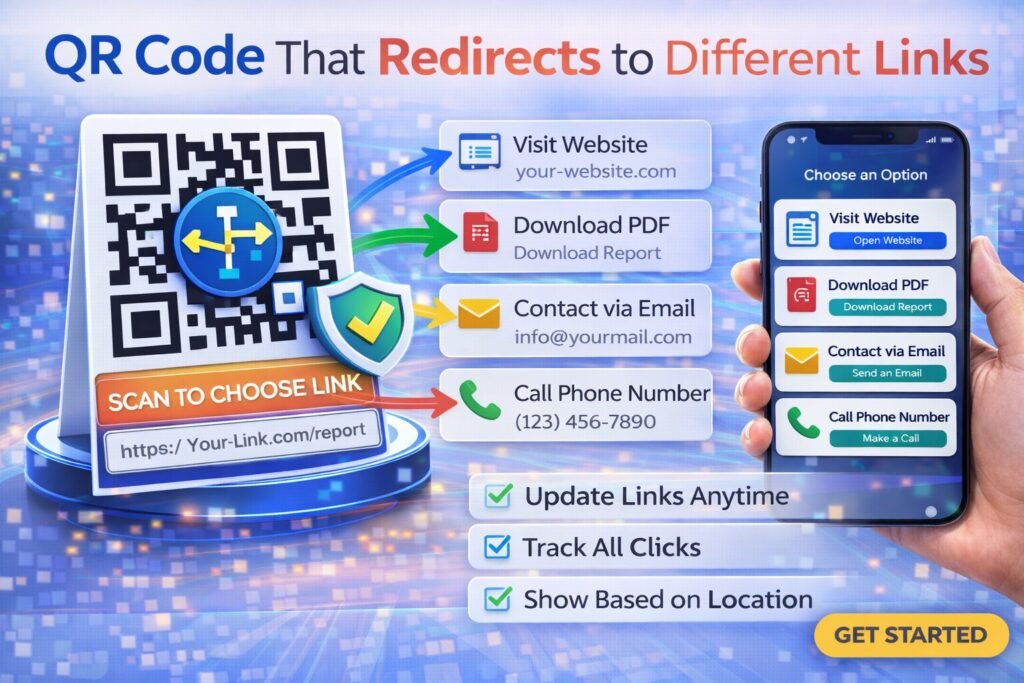
A QR code that redirects to different links is a dynamic QR code configured with routing logic. When scanned, the QR system determines which destination to send the user to based on predefined conditions.
Unlike static QR codes that contain a fixed URL, redirectable QR codes use a server-based system.
The scan workflow typically looks like this:
- User scans QR code
- Request reaches redirect server
- System evaluates routing rules
- User is redirected to the appropriate link
This allows one QR code to serve multiple marketing or operational purposes.
Why Businesses Use Multi-Redirect QR Codes
Companies increasingly adopt multi-link QR codes because they enable smarter marketing and better customer targeting.
Campaign Personalization
Different audiences can be directed to tailored content.
Example:
- New customers → introductory page
- Returning customers → loyalty offers
Global Marketing Campaigns
International brands use geo-redirect QR codes to send users to localized websites.
Example:
- Users in France → French landing page
- Users in the USA → English landing page
Event Promotions
Event organizers can update QR destinations as the event timeline progresses.
Example:
- Before event → registration page
- During event → live schedule
- After event → feedback form
A/B Testing
Marketers can test multiple landing pages using one QR code.
This helps identify the highest-converting content.
Product Launch Campaigns
QR codes on packaging can direct users to evolving promotional pages.
How Dynamic QR Redirect Systems Work
The core technology behind redirectable QR codes is a server-based redirect infrastructure.
Instead of encoding the final destination URL, the QR code encodes a redirect link.
Example encoded link:
qrplatform.com/abc123
When scanned:
- The redirect server receives the scan request
- The system evaluates routing conditions
- Analytics data is recorded
- The user is redirected to the selected link
Because the destination link lives on the server, it can be modified anytime.
Platforms such as ProQRCodeGenerator.com provide dynamic QR systems with routing logic and analytics dashboards that allow businesses to manage multi-destination campaigns.
Types of QR Redirect Logic
Different routing strategies can be applied to redirectable QR codes.
Geo-Based Redirects
Users are redirected based on their geographic location.
Example:
- USA → US website
- UK → UK website
This improves localization.
Time-Based Redirects
The destination changes after a certain date or time.
Example:
- Pre-launch → teaser page
- Launch day → product page
- Post-launch → discount page
Device-Based Redirects
QR codes can detect device type.
Example:
- iOS users → App Store
- Android users → Google Play
Campaign-Based Routing
Marketing campaigns may use different landing pages for different promotions.
A/B Testing Redirects
Traffic is split across multiple landing pages to test performance.
Step-by-Step Guide to Creating Redirectable QR Codes
Creating a QR code that redirects to different links involves several steps.
Step 1 – Choose a Dynamic QR Platform
Select a QR generator that supports:
- multi-link redirects
- analytics tracking
- editing capabilities
- campaign segmentation
Step 2 – Create the Base QR Code
Generate a dynamic QR code containing the redirect link.
Step 3 – Configure Routing Logic
Set rules for:
- location-based routing
- time-based changes
- device detection
- campaign segmentation
Step 4 – Test Redirect Conditions
Test scans under different scenarios to ensure correct ruting.
Step 5 – Deploy QR Code Campaign
Place the QR code on marketing materials, packaging, or digital assets.
Step 6 – Monitor Analytics
Track performance through the platform’s dashboard.
Tools such as ProQRCodeGenerator.com allow marketers to monitor scan behavior and adjust routing strategies accordingly.
Best Tools for Multi-Link QR Codes
Businesses require robust QR systems for redirect campaigns.
Important features include:
- dynamic QR generation
- conditional redirect rules
- analytics dashboards
- custom branding
- unlimited scan handling
Professional QR platforms combine these features into centralized campaign management tools.
QR Analytics and Smart Targeting
One major advantage of redirectable QR codes is analytics-driven optimization.
Businesses can track:
- scan volume
- geographic distribution
- device usage
- engagement patterns
Example analytics dashboard:
| Metric | Example |
|---|---|
| Total scans | 2,400 |
| Top region | California |
| Peak scan time | 8 PM |
| Conversion rate | 12% |
These insights help marketers refine targeting strategies.
Business Use Cases for Redirectable QR Codes
Multi-link QR codes are used across industries.
Global Marketing Campaigns
Brands with international audiences can provide localized content.
Event Marketing
Event QR codes can evolve throughout the event lifecycle.
Retail Promotions
Retailers can redirect users to seasonal promotions.
Real Estate Listings
Agents can redirect QR codes to updated property listings.
Product Packaging
Manufacturers can update promotional pages after product launch.
ROI Benefits of Smart QR Campaigns
Redirectable QR codes improve marketing ROI by enabling:
- real-time campaign optimization
- measurable engagement tracking
- personalized customer journeys
Example:
A campaign using A/B testing QR redirects increases conversion rate from 5% to 12%.
Without dynamic routing, this optimization would not be possible.
Common Mistakes to Avoid
Businesses often misuse redirectable QR codes.
Using Static QR Codes
Static codes cannot support routing logic.
Poor Testing
Always test redirect conditions thoroughly.
Broken Routing Rules
Incorrect logic can lead to incorrect landing pages.
Ignoring Analytics
Scan data must be analyzed regularly.
Optimization Tips
To maximize campaign performance:
- use clear call-to-action text
- ensure mobile-optimized landing pages
- place QR codes in visible locations
- monitor analytics regularly
These strategies increase engagement.
Security and Privacy Considerations
Redirectable QR systems must maintain strong security standards.
Best practices include:
- HTTPS redirects
- secure hosting infrastructure
- compliance with data privacy regulations
Professional QR platforms provide secure redirect environments to protect users.
Frequently Asked Questions
Can a QR code redirect to different links?
Yes, dynamic QR codes can route users to diffeent destinations based on conditions.
How do smart QR codes work?
They use server-based routing logic to determine the destination.
Can QR codes change destination automatically?
Yes, time-based or rule-based redirects allow automatic changes.
Are redirectable QR codes trackable?
Yes, dynamic QR platforms provide scan analytics.
Do redirectable QR codes expire?
They remain active as long as the hosting platform is active.
Conclusion: Using Smart QR Redirects for Advanced Marketing
A QR code that redirects to different links enables businesses to create intelligent, adaptable marketing campaigns.
Instead of static destinations, dynamic QR routing allows:
- personalized user experiences
- global campaign targeting
- A/B testing and optimization
- real-time link updates
- analytics-driven decision-making
Platforms such as ProQRCodeGenerator.com provide dynamic QR infrastructure, analytics dashboards, and routing logic tools that help businesses manage advanced QR campaigns efficiently.
As marketing becomes more data-driven and personalized, redirectable QR codes are becoming essential tools for modern digital strategy.