Table of Contents
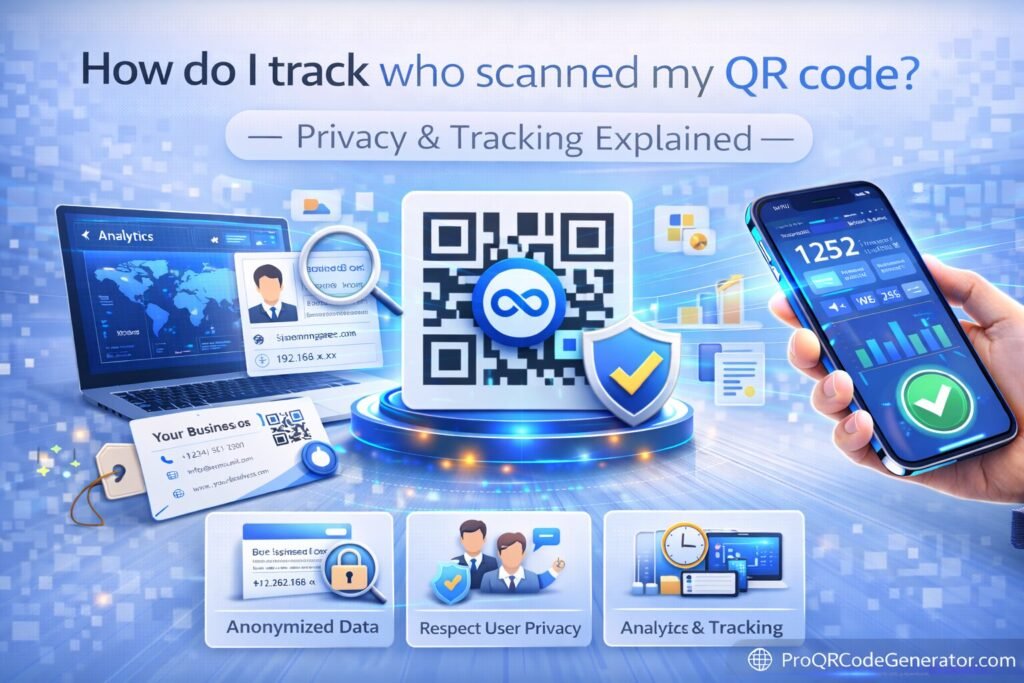
Data attribution is the bedrock of modern marketing. When you invest thousands of dollars into direct mail, trade show banners, or product packaging, you need to measure the return on that investment. The physical-to-digital bridge relies almost entirely on quick response technology, prompting one critical question from every data-driven marketing director: how do I track who scanned my QR code?
The answer requires navigating a complex intersection of technical web architecture, global privacy legislation, and conversion psychology. To put it bluntly: a smartphone camera does not natively transmit a user’s name, email address, or phone number to a server simply because they scanned a visual matrix. Doing so would be a catastrophic violation of global privacy laws.
However, you can build an infrastructure that tracks the exact location, time, and device of the scan, while simultaneously deploying mechanisms that legally and seamlessly capture the user’s personal identity. This comprehensive guide dissects the reality of offline data attribution. We will explore what data is freely available, the technical routing required to capture it, and the strategic funnels you must build to definitively track exactly who is engaging with your offline campaigns.
The Reality of QR Code Tracking: What You Can and Cannot See
Before building a tracking infrastructure, it is vital to separate marketing myths from technical realities.
The Privacy Barrier: Why Native Identity Tracking is Impossible
When a user points their iOS or Android camera at a printed code, the operating system reads the encoded URL and prompts the user to open it in their browser. At this stage, the smartphone explicitly blocks the transmission of Personally Identifiable Information (PII). You cannot pull a user’s Apple ID, Google account details, phone number, or biometric data through a standard scan.
If you are asking, how do I track who scanned my QR code? with the expectation that a dashboard will magically populate with a list of names from anonymous scans, you are operating on a misconception of mobile security protocols.
Device Data vs. Personal Identity
What you can track natively is Device Data. When the smartphone browser initiates the request to open your link, it must perform a server “handshake.” During this fraction of a second, the server logs metadata.
To track the actual person behind the device, you must bridge the gap between anonymous device data and voluntary identity submission. This is achieved through a two-step tracking methodology.
How do I track who scanned my QR code? (The Two-Step Method)
To build a complete attribution profile, you must use dynamic architecture paired with a conversion gateway.
Step 1: Capturing the Scan Event (Dynamic Routing)
You cannot track a static QR code. A static code hard-codes your final website URL directly into the image. The user goes straight from their camera to your website, bypassing any opportunity for specific offline-to-online attribution.
To track the scan event, you must use a Dynamic QR Code. A dynamic code encodes a short, secure routing link (e.g., qr.yourbrand.com/123).
- The user scans the code.
- The phone pings the dynamic routing server.
- The server instantly logs the device’s location, time, and OS.
- The server redirects the user to your final destination.
This step answers the “Where,” “When,” and “How” of the scan.
Step 2: Capturing the Identity (The Conversion Point)
Once the dynamic server has tracked the scan metrics, the user lands on your digital real estate. To answer how do I track who scanned my QR code?, this destination must be engineered to capture identity.
- The Lead Magnet: The destination page offers a discount code in exchange for an email address.
- The vCard Exchange: The destination is a digital business card that prompts the user to “Share Your Info in Return” before they can download your contact details.
- The Gated Asset: The scan leads to a high-value PDF report that requires a LinkedIn login to access.
By tying the analytics of Step 1 to the CRM submission of Step 2, you create a complete, fully identified user profile.
What Data Can a Dynamic QR Code Actually Track?
When you utilize an enterprise-grade tracking platform, the metadata captured during the dynamic routing phase is extensive. Here is exactly what populates in a professional analytics dashboard.
Geographic Heatmaps and Location Data
Tracking platforms use IP address analysis to determine the geographic origin of the scan. While it will not give you the user’s exact street address or GPS coordinates (due to privacy limits), it accurately identifies the city, state, and country.
- Strategic Value: If you run a national print campaign, you can instantly see if your engagement is concentrated in the Northeast or the Sunbelt, allowing you to reallocate future print budgets accordingly.
Timestamps and Scan Velocity
Every scan generates a precise timestamp. Over time, this data reveals engagement velocity and peak hours.
- Strategic Value: A restaurant might discover that its storefront window code is scanned most frequently between 10:00 PM and midnight—after they are closed. This data justifies changing the dynamic link destination during those hours to an “Order for Tomorrow” delivery scheduling page.
Operating Systems and Device Types
The tracking server reads the “User-Agent” string of the incoming browser. This tells you whether the user is on an iPhone, an Android device, a tablet, or a desktop.
- Strategic Value: If 85% of your scanners are utilizing iOS, your development team knows to prioritize Safari compatibility and Apple Pay integrations on the destination landing page.
Total vs. Unique Scans
Understanding frequency is critical for accurate ROI modeling.
- Total Scans: The absolute number of times the routing link was triggered.
- Unique Scans: The number of distinct devices that scanned the code. If one user scans your trade show banner four times in one day, it registers as four total scans but only one unique scan.
(To access this level of granular, real-time metadata, marketers rely on platforms like ProQRCodeGenerator.com, which processes these analytics in the background while maintaining strict compliance with global privacy regulations.)
The Mechanics: How QR Code Analytics Work Under the Hood
To fully master your tracking strategy, it is helpful to understand the server-side mechanics. When someone asks a developer, how do I track who scanned my QR code?, the developer looks at the HTTP request headers.
- The DNS Resolution: The smartphone translates the dynamic short link into an IP address.
- The HTTP GET Request: The mobile browser requests the webpage from the tracking server.
- Log Generation: The server records the
REMOTE_ADDR(IP for location) and theHTTP_USER_AGENT(for device info). - The 301/302 Redirect: The server responds with an HTTP status code (usually a 302 Temporary Redirect for dynamic codes) and the
Locationheader pointing to your actual website. - Cookie Placement (Optional): If the tracking platform utilizes first-party tracking, it may assign an anonymous session cookie to the device to accurately track repeat scans.
This entire computational sequence occurs in less than 300 milliseconds.
Business Applications: Identifying Your Scanners Legally
How do enterprise companies bridge the gap between anonymous metadata and personal identification? They design specialized business applications tailored to their industry.
B2B Networking and vCard Plus Tracking
At conferences, sales executives use dynamic vCard QR codes. When a prospect scans the code, they see the executive’s digital profile. However, to save the contact directly to their phone, the prospect is prompted by a subtle form: “Enter your email to receive my full contact file.” The anonymous scan instantly becomes a qualified, named lead in the executive’s CRM.
Retail Lead Generation and Gated Content
A cosmetics brand prints a QR code on their product packaging reading: “Scan for a video tutorial on how to apply this product.” The scan routes the user to a mobile-optimized page. The video plays for 10 seconds before pausing with a prompt: “Unlock the full 5-minute tutorial and a 15% refill discount by entering your email.”
Hospitality and Contactless Ordering
Modern restaurants track exactly who is sitting at which table. The QR code on Table 4 routes to the digital menu. When the customer places an order via their phone, they pay using Apple Pay or Google Pay. The payment gateway captures their name and email, perfectly tying the anonymous physical scan at Table 4 to a known customer identity.
Industry Examples of Identity-Driven QR Campaigns
- Real Estate: A brokerage places unique dynamic codes on “For Sale” signs. When scanned, the user is taken to a 3D virtual tour. To view the pricing and floorplans, the user must authenticate via a Google or Facebook login API. The agent immediately receives a notification: “John Doe ([email protected]) just scanned the sign at 123 Main St.”
- SaaS and B2B Software: At a trade show, a software company displays a massive QR code on their booth reading “Scan to enter the iPad giveaway.” The code routes to a Typeform. To enter, the user inputs their name, company, and biggest software pain point. The tracking server confirms they were physically at the booth, and the form confirms their identity.
Step-by-Step Guide: Building a Fully Trackable QR Campaign
If you are ready to stop guessing and start tracking, execute this exact deployment sequence:
Step 1: Define the Conversion Point (The “Who”)
Decide how you will capture the user’s identity. Will it be an email newsletter signup, a discount code claim form, a webinar registration, or an account creation page? Build this mobile-optimized destination page first.
Step 2: Append UTM Parameters to Your URL
Before creating your QR code, take the URL of your destination page and add UTM (Urchin Tracking Module) parameters.
Example: https://yourbrand.com/landingpage?utm_source=qr&utm_medium=print&utm_campaign=trade_show_2026
This ensures that when the user lands on your site, Google Analytics knows exactly which physical code drove them there.
Step 3: Generate a Dynamic Routing Link
Use a professional SaaS tool to encode that long UTM link into a dynamic QR code.
(Tip: Utilizing an enterprise-grade platform like ProQRCodeGenerator.com ensures your dynamic links will never expire and can handle unlimited scan volume without breaking.)
Step 4: Centralize the Data
Once the campaign is live, monitor two dashboards. Use your QR platform’s dashboard to track scan volume, geographic heatmaps, and time-of-day engagement. Use your CRM (or Google Analytics) to track the names, emails, and conversion rates of the people who completed the form.
Analytics Dashboard Comparison: Professional vs. Free Tools
The quickest way to fail at offline tracking is to use a free consumer tool. Here is a comparison of what you see when you ask, how do I track who scanned my QR code?, based on the software you choose.
| Tracking Capability | Free / Static Generator | Professional SaaS Platform |
| Total Scans | No Data Available | Real-Time Data |
| Unique Scans (Device Tracking) | No Data Available | Accurate First-Party Logging |
| Geographic Heatmaps | No Data Available | City / Region Level Analytics |
| Time & Date Stamping | No Data Available | Granular Chronological Data |
| Device OS Logging | No Data Available | iOS vs. Android Breakdown |
| Post-Print Link Editing | Impossible | Instant Dashboard Updates |
Integrating Scan Data with Your CRM and Google Analytics
To truly track who scanned your code, the data from the physical scan must communicate with your sales infrastructure.
The QR to GA4 Pipeline
By utilizing the UTM parameters discussed in the step-by-step guide, you bridge the gap between offline and online. Inside Google Analytics 4 (GA4), you can navigate to Acquisition > Traffic Acquisition and filter by “Session source/medium.” Your QR codes will populate here. You can then track the entire customer journey: did the person who scanned the magazine ad spend 3 minutes reading your blog, or did they immediately bounce?
Webhooks and CRM Automation
Advanced tracking setups utilize Webhooks or Zapier integrations. When a user scans a dynamic code and lands on a HubSpot or Salesforce form, filling out that form triggers an automation. The CRM instantly tags the new contact with “Source: Offline QR Campaign – Store Window,” automatically entering them into an email drip campaign tailored to local shoppers.
ROI Discussion: Valuing the Who Behind the Scan
Why go through the effort of building dynamic routing and conversion funnels? Because knowing who scans your codes drastically alters your Customer Acquisition Cost (CAC).
If you spend $5,000 on a billboard and have no tracking, your ROI is a total guess.
If you use a dynamic QR code and track 1,000 unique scans, you know your Cost Per Scan (CPS) is $5.00.
If you use a dynamic code paired with an email capture form, and 200 people submit their email, you know your Cost Per Lead (CPL) from that physical billboard is $25.00.
By identifying the user, you transition physical marketing from a “brand awareness” expense into a measurable, performance-based revenue channel.
Mistakes to Avoid: The Quickest Way to Lose Scanner Trust
When trying to capture identity, aggressive tactics will ruin your conversion rate. Avoid these critical errors:
- Asking for Too Much Information Too Soon: If a user scans a code for a restaurant menu and is immediately hit with a form demanding their phone number and home address, they will close the browser. Match the ask to the value of the reward.
- Failing to Optimize for Mobile: 100% of QR code scans occur on mobile devices. If your lead-capture form requires pinching, zooming, or typing long responses on a small keyboard, your drop-off rate will be catastrophic.
- Using Bait-and-Switch Tactics: Do not print “Scan for a Free Coffee” if the code actually leads to a 30-page survey they must complete first. Trust is paramount when asking for personal identity.
Optimization Tips for High-Converting QR Destinations
To maximize the number of anonymous scans that convert into known identities, optimize your destination pages:
- Implement Auto-Fill: Ensure your forms support browser auto-fill so users can input their name and email with a single tap.
- Use Social Login Options: Instead of requiring typed emails, offer “Continue with Google” or “Continue with Apple.” This reduces friction to a single click and provides you with their verified email address.
- Keep Above the Fold: The value proposition and the data-capture form must be visible immediately upon the page loading, without the user having to scroll down.
Security & Privacy Considerations (GDPR, CCPA, and Apple iOS Changes)
When you ask how do I track who scanned my QR code?, you must ask it within the confines of international law.
GDPR and IP Anonymization
Under the General Data Protection Regulation (GDPR) in Europe, an IP address is considered personal data. Professional tracking platforms handle this by anonymizing the last octet of the IP address before storing it. This allows the platform to determine the city and country for your heatmaps without logging the user’s exact, identifiable network address, keeping you perfectly legally compliant.
Apple’s Privacy Protocols
Apple iOS includes features like “Hide My Email” and “Intelligent Tracking Prevention.” This means you cannot rely on invasive third-party cookies to track users across the web after they scan your code. Your tracking strategy must rely on First-Party Data—meaning data the user explicitly and voluntarily gives directly to you via your conversion forms.
Frequently Asked Questions (FAQ)
How do I track who scanned my QR code?
You track the scan metrics (location, time, device) using a dynamic QR code routing server. To track the person (name, email), you must direct that dynamic scan to a landing page featuring a lead-capture form or CRM integration.
Can a QR code automatically steal my phone number or email?
No. Mobile operating systems block websites from automatically extracting your phone number, email, or contacts simply by scanning a QR code. The user must manually input or authorize the sharing of this data.
Is it possible to track a free static QR code?
No. Static codes link directly to the destination URL without passing through a tracking server. To gather analytics, you must use a dynamic QR code.
What is the difference between total scans and unique scans?
Total scans count every single time the code is read by a camera. Unique scans count the number of individual devices that scanned the code, filtering out multiple scans by the same person.
Can I see the exact GPS location of the person who scanned my code?
No. For privacy reasons, tracking platforms use IP-address geolocation, which provides the city, state, and country of the scan, but not pinpoint GPS street coordinates.
How do I integrate QR scans into Google Analytics?
Append UTM parameters (source, medium, campaign) to your final destination URL, and then encode that complete URL into a dynamic QR code. When scanned, GA4 will log the traffic exactly as it would a digital ad click.
Conclusion: Mastering the Offline-to-Online Handshake
The question of how do I track who scanned my QR code reveals the ultimate goal of modern offline marketing: eliminating anonymity. While privacy laws rightfully prevent you from silently extracting a user’s identity through a camera lens, the combination of dynamic tracking architecture and intelligent conversion design provides a powerful, ethical alternative.
By deploying dynamic codes, you gain total visibility into the operational metrics of your campaigns—where your audience is, what devices they use, and when they engage. By directing those tracked scans to highly optimized, value-driven capture pages, you seamlessly convert anonymous mobile data into actionable, named leads.
Stop treating your print collateral as untrackable expenses. Build a compliant, high-converting tracking infrastructure and take control of your offline data attribution.