Table of Contents
When operations managers, marketing directors, and enterprise owners evaluate digital-to-physical infrastructure, a common and critical question arises: which QR code is best for business? Deploying the wrong type of matrix barcode on a mass print run, product packaging line, or global direct mail campaign is an expensive mistake. A QR code is no longer just a digital novelty; it is a critical bridge linking your offline assets to your online conversion funnels. If that bridge collapses because the underlying technology is rigid, untrackable, or prone to link rot, you lose customer trust and waste thousands of dollars in printing costs.
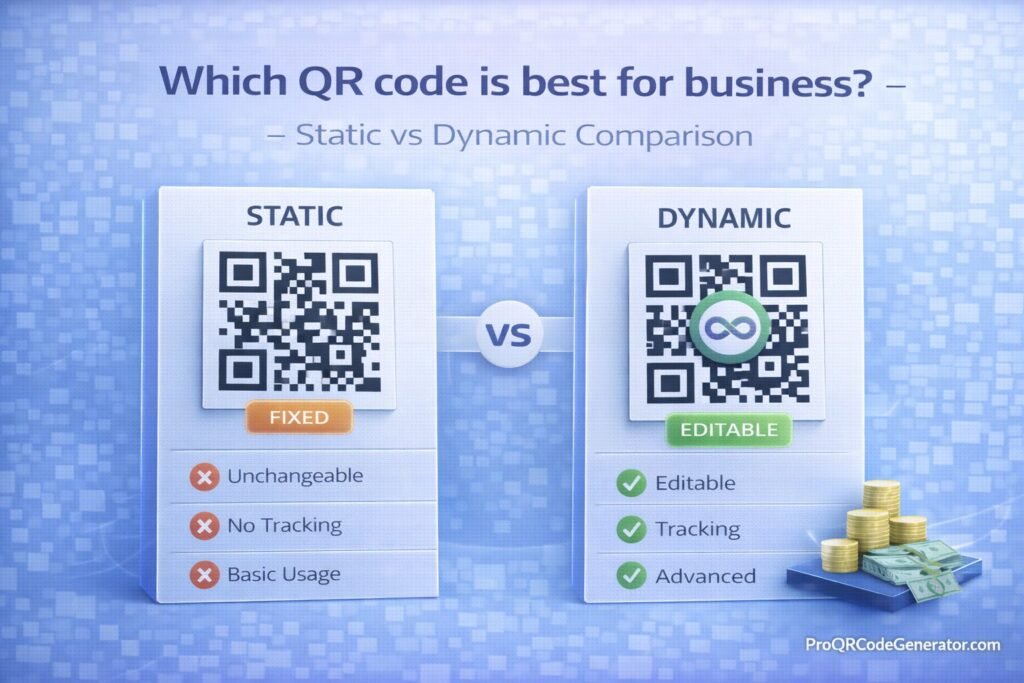
To definitively answer which QR code is best for business, we must conduct a deep technical and strategic comparison between the two foundational architectures: Static QR Codes and Dynamic QR Codes.
This comprehensive guide breaks down how each technology functions at the server level, evaluates their respective ROI, and outlines the features your enterprise needs to scale securely and efficiently.
What is a QR Code? A Brief Primer for Businesses
A Quick Response (QR) code is a two-dimensional matrix barcode capable of storing significantly more data than a traditional 1D UPC barcode. Originally developed in the 1990s by Denso Wave to track automotive parts, the technology has evolved into a universal standard for mobile consumer engagement.
For businesses, a QR code acts as a physical hyperlink. By utilizing the native camera on an iOS or Android device, a consumer can instantly bypass the friction of typing a URL, searching for a product, or manually entering contact information.
However, the visual square you print on a brochure is only half of the equation. The digital routing logic that powers that square determines its utility in a corporate environment.
How Do QR Codes Work? The Infrastructure Level
Before evaluating which QR code is best for business applications, it is essential to understand how data is processed within the matrix. The physical appearance of the code changes based on the amount of data it holds, which directly impacts scannability.
The Anatomy of the Matrix
A QR code consists of several key elements:
- Finder Patterns: The three large squares in the corners that tell the smartphone camera where the code is and how it is oriented.
- Alignment Patterns: Smaller squares that help the scanner read the code even if it is printed on a curved surface (like a wine bottle).
- Data Modules: The individual black and white pixels that contain the actual binary information.
- Quiet Zone: The mandatory blank space surrounding the code that isolates it from external design elements.
The way these data modules are utilized forms the primary difference between static and dynamic architectures.
Static QR Codes: The Permanent, Unchangeable Option
When you ask an entry-level marketer which QR code is best for business, they might point to a free static generator. This is almost always a strategic error for enterprise campaigns.
How Static Codes Encode Data
A static QR code hardcodes your destination data directly into the black and white pixel pattern. If you encode a 100-character URL, those exact 100 characters are translated into the matrix.
Characteristics of Static Codes
- Permanent Destination: Once printed, the data cannot be changed. If your website goes down, or the specific promotional page is deleted, the QR code becomes a dead link (404 error).
- No Analytics: Because the smartphone reads the final URL directly from the image and opens it in the browser, the data never passes through a tracking server. You cannot track how many times the code was scanned.
- High Visual Density: The more data you encode (e.g., a massive VCard file or a long UTM-tagged URL), the denser and more complex the pixel pattern becomes. Highly dense codes require high-resolution printing and take longer for older smartphone cameras to decode.
When Static Makes Sense for Business
Static codes have very narrow enterprise use cases. They are only appropriate when the data must remain permanently fixed and tracking is entirely irrelevant.
- Employee ID Badges: Encoding a fixed employee identification number.
- Offline Plain Text: Serial numbers or batch codes printed directly onto manufacturing parts.
- Secure WiFi Access: Encoding SSID and passwords for guest networks in office lobbies.
Dynamic QR Codes: The Editable, Trackable Engine
For 99% of commercial applications, the answer to which QR code is best for business is definitively the Dynamic QR Code.
The Short-URL Redirection Mechanism
Instead of hardcoding the final destination data into the image, a dynamic QR code encodes a short, intermediate URL (e.g., qr.yourcompany.com/promo1).
When a consumer scans the code, the smartphone visits that short URL. The short URL is hosted on a professional SaaS routing server. In milliseconds, the server logs the scan data, looks up the final destination URL you have specified in your dashboard, and executes a 301 or 302 redirect, seamlessly landing the user on the correct page.
The Enterprise Advantage of Dynamic Architecture
- Complete Editability: You can change the final destination URL at any time without ever altering the printed QR code.
- Advanced Analytics: Because the scan routes through a server, you can capture vital marketing data, including time of scan, geographic location, and device type.
- Low Visual Density: Because the code only holds a short URL, the pixel pattern remains clean, simple, and incredibly fast for cameras to scan, even in low light or at a distance.
Comparison: Static vs. Dynamic QR Codes (The Showdown)
To clearly illustrate which QR code is best for business, here is a direct comparison of features.
| Feature / Capability | Static QR Code | Dynamic QR Code | Business Impact |
| Edit Destination Post-Print | No | Yes | Prevents thousands of dollars in reprint costs if a URL changes. |
| Scan Analytics & Tracking | No | Yes | Allows for precise ROI calculation on physical marketing spend. |
| Data Density (Scannability) | High (Harder to scan) | Low (Fast, reliable scans) | Ensures better user experience and higher conversion rates. |
| Error Correction Flexibility | Limited by size | High | Code remains scannable even if partially damaged or obscured. |
| Ongoing Maintenance | None | Requires SaaS subscription | Trades a minor software cost for massive operational agility. |
Benefits of Using the Best QR Code for Business
Understanding the mechanics is only the first step. The true value lies in how dynamic routing technology impacts your bottom line and operational efficiency.
1. Massive Cost Savings on Print Collateral
Consider a national restaurant chain that prints 50,000 premium, laminated menus. If they use a static QR code to link to their seasonal allergen information, and the URL for that PDF changes, all 50,000 menus are instantly obsolete. By utilizing a dynamic QR code from a platform like ProQRCodeGenerator.com, the IT team simply updates the PDF file linked in the dashboard. The physical menus remain perfectly functional, saving tens of thousands of dollars in reprinting and distribution logistics.
2. Real-Time Marketing Agility
A printed billboard is typically a rigid asset. A dynamic QR code transforms it into an agile digital endpoint. A retailer can use the exact same billboard QR code to route morning commuters to a coffee promotion, and evening commuters to a dinner discount. The physical asset never changes, but the digital strategy pivots in real-time.
3. Granular Attribution for Offline Campaigns
Historically, marketers struggled to prove the ROI of direct mail or print advertising. Dynamic codes provide closed-loop attribution. By appending UTM parameters to the destination URL inside the dynamic routing dashboard, businesses can track exactly how much website traffic, lead generation, and revenue originated from a specific print asset.
Business Applications & Industry Examples
How are elite organizations deploying dynamic QR infrastructure to drive conversions and reduce friction?
Retail & CPG Packaging
Consumer Packaged Goods (CPG) companies face severe regulatory pressure to include vast amounts of information (ingredients, sourcing, disposal instructions) on small physical packages. By printing a single dynamic QR code on the label, they link consumers to a mobile-optimized landing page. If a regulatory requirement changes the wording of a disclaimer, the brand updates the digital page, keeping millions of products on store shelves fully compliant without a recall.
Real Estate Marketing
Real estate brokerages rely heavily on yard signs. A dynamic QR code on a “For Sale” sign can link to a virtual tour of the property. Once the house sells, the agent moves the physical sign to a new listing and updates the QR code’s destination in their software dashboard to reflect the new property. The expensive metal signage becomes infinitely reusable.
Restaurant & Hospitality Operations
Beyond digital menus, hospitality brands use dynamic QR codes in hotel rooms for room service ordering, WiFi access, and concierge requests. Because these are dynamic, the hotel can instantly update the room service menu pricing across all 500 rooms simultaneously with one click in their management portal.
Step-by-Step Guide: Creating Your Business QR Code
When you have determined which QR code is best for business, execution is the next critical phase. Here is how to deploy a professional, non-expiring dynamic code.
- Select an Enterprise-Grade Generator: Avoid “free” tools that cap scans or inject third-party ads. Choose a dedicated business solution like ProQRCodeGenerator.com that guarantees server uptime and unlimited scan volume.
- Define the Campaign Goal: Are you routing to a URL, a downloadable PDF, a WhatsApp customer service chat, or an interactive vCard? Select the correct data type.
- Input the Destination and Select “Dynamic”: Enter your final URL. Ensure the system is set to generate a dynamic code to secure your future editability.
- Brand the Experience: Customize the QR code to align with your corporate identity. Add your company logo to the center, adjust the data pattern colors to match your hex codes, and include a clear Call to Action (CTA) frame (e.g., “Scan to Download App”).
- Set Error Correction to Level M or Q: This ensures the code can sustain minor printing imperfections or physical wear and tear while remaining fully readable.
- Download as a Vector File: For professional print, always export the code as an SVG, EPS, or PDF. Unlike PNGs or JPGs, vector files do not pixelate when scaled, ensuring crisp edges whether printed on a business card or a massive convention banner.
- Test Across Multiple Devices: Scan the digital proof with both the latest iPhone and an older Android device to verify the redirect speed and mobile optimization of the landing page.
(Need to generate 1,000 unique codes for a direct mail campaign? Explore the bulk generation tools inside ProQRCodeGenerator.com.)
Advanced Analytics & Tracking
The primary reason dynamic architecture answers the question of which QR code is best for business is data acquisition.
When you manage your codes through a professional SaaS platform, you unlock a dashboard of actionable intelligence:
- Total vs. Unique Scans: Understand if 500 different people scanned your code, or if 50 highly engaged people scanned it 10 times each.
- Geographic Heatmapping: Track scans down to the city level. If a print ad runs in three cities, the analytics dashboard will reveal exactly which demographic is interacting the most.
- Time & Date Logging: Identify peak engagement windows. If your product packaging is predominantly scanned on weekends, you can tailor your email follow-up sequences accordingly.
- Device Operating Systems: Knowing whether your audience uses iOS or Android allows your development team to prioritize the correct app store links or optimize mobile web experiences specifically for the dominant browser (Safari vs. Chrome).
Calculating ROI on Professional QR Software
Many businesses hesitate to pay a subscription for a QR code generator when “free” alternatives exist. This hesitation usually vanishes when the true cost of a broken link is calculated.
The “Free” Generator Risk Scenario:
A regional bank prints 20,000 brochures detailing a new mortgage rate, featuring a free QR code. Two weeks later, the free provider shuts off the code because it exceeded a hidden “500 scan limit.”
- Cost of printing & distribution: $15,000.
- Lost potential mortgage revenue: Immeasurable.
- Brand reputation damage: Severe.
The Professional SaaS ROI:
By investing in an enterprise platform, the bank pays a predictable, minor annual fee. In return, they receive a guarantee of unlimited scans, 99.9% server uptime, and the ability to edit the link instantly if interest rates change. The ROI of averting a single print disaster pays for the software for decades.
Security Considerations for Corporate QR Campaigns
In a corporate environment, security is paramount. “QR Phishing” (Quishing) is a rising threat where malicious actors attempt to deceive users via fake matrix codes.
When choosing which QR code is best for business, the underlying platform must offer robust security features:
- Custom Domain Masking (White-labeling): Instead of users seeing a generic short-link (e.g.,
qr-free-maker.com/123), the dynamic code routes through your own branded domain (e.g.,link.yourbank.com/promo). This assures the consumer that the link is safe and legitimate. - SSL Encryption: The routing server must be secured via HTTPS to protect data in transit.
- SOC2 Compliance & SSO: Enterprise platforms must protect the dashboard itself, utilizing Single Sign-On (SSO) and strict user permissions so only authorized marketing managers can change where a dynamic code points.
Mistakes to Avoid When Choosing a Generator
Even when utilizing dynamic architecture, poor execution can destroy a campaign. Avoid these common enterprise pitfalls:
- The “Orphan Code” Phenomenon: Placing a bare QR code on a poster with no context. Consumers will not scan a code if they don’t know what happens next. Always pair the code with a clear value proposition (e.g., “Scan for 3D Product View”).
- Violating Contrast Rules: Brand teams often try to make QR codes blend into the background by using light colors. A smartphone camera relies on high contrast. Always ensure the data pattern is significantly darker than the background.
- Ignoring the Mobile Destination: A dynamic QR code is a mobile-first bridge. If you route users to a legacy desktop website where they must pinch and zoom to read the text, your bounce rate will be near 100%. Ensure the destination is rigorously mobile-optimized.
Optimization Tips for Maximum Scan-Through Rates
To transform your QR deployment from a passive feature into an active conversion driver, implement these optimization strategies:
- Incentivize the Action: Offer an immediate reward for scanning. “Scan to read our history” yields low engagement. “Scan for an instant $10 discount code” drives massive volume.
- Strategic Sizing: The general rule for print is that a QR code should have a minimum size of 0.8 x 0.8 inches. Furthermore, the scanning distance ratio is roughly 10:1. If a code is on a poster 100 inches away from the user, the code must be at least 10 inches wide.
- Visual Trust Indicators: Always embed your corporate logo in the center of the code. This not only builds brand equity but serves as a visual safeguard against malicious stickers being placed over your collateral.
Frequently Asked Questions (FAQ)
Which QR code is best for business?
Dynamic QR codes are unequivocally the best choice for business. They allow you to edit the destination URL after printing, track granular scan analytics, and maintain a simple, fast-scanning visual pattern.
Are free QR code generators safe for enterprise use?
No. Free generators often cap scan limits, inject third-party advertisements, or abruptly delete codes to force paid upgrades, making them a massive liability for professional campaigns.
Can I track who scans my business QR code?
You cannot track Personally Identifiable Information (PII) like a name or phone number just from a scan. However, with a dynamic code, you can track the geographic location, device type, time of scan, and total scan volume.
What happens if I need to change my website URL after printing brochures?
If you used a Static QR code, you must reprint the brochures. If you used a Dynamic QR code, you simply log into your management dashboard and update the destination URL. The printed brochures will instantly route to the new site.
What is the best file format for printing business QR codes?
Always request vector formats like SVG, EPS, or PDF. Unlike PNGs, vector files can be scaled to the size of a billboard without becoming pixelated or blurry.
Do dynamic QR codes expire?
Dynamic codes only expire if the software platform hosting the redirection link goes offline or if you cancel your subscription. Choosing a reliable enterprise platform ensures long-term permanence.
How many scans can a dynamic QR code handle?
Professional platforms like ProQRCodeGenerator.com are built on scalable cloud infrastructure and offer unlimited scans, ensuring your code remains active even during viral, high-traffic events.
Conclusion: Future-Proofing Your Enterprise
The debate over which QR code is best for business is settled decisively by the need for agility, data attribution, and risk management. While static codes serve a purpose in niche, permanent data-encoding scenarios, they are rigid and untrackable.
Dynamic QR codes represent the modern standard for enterprise connectivity. By utilizing a managed redirection layer, businesses can decouple the physical printed asset from the digital destination. This capability prevents costly reprint disasters, provides deep analytics into offline consumer behavior, and allows marketing teams to pivot campaigns in real-time.
To leverage this technology effectively, businesses must move away from unreliable free tools and adopt robust, secure SaaS infrastructure. By prioritizing high-resolution vector exports, custom branding, and guaranteed server uptime, you ensure that every scan delivers a flawless brand experience.